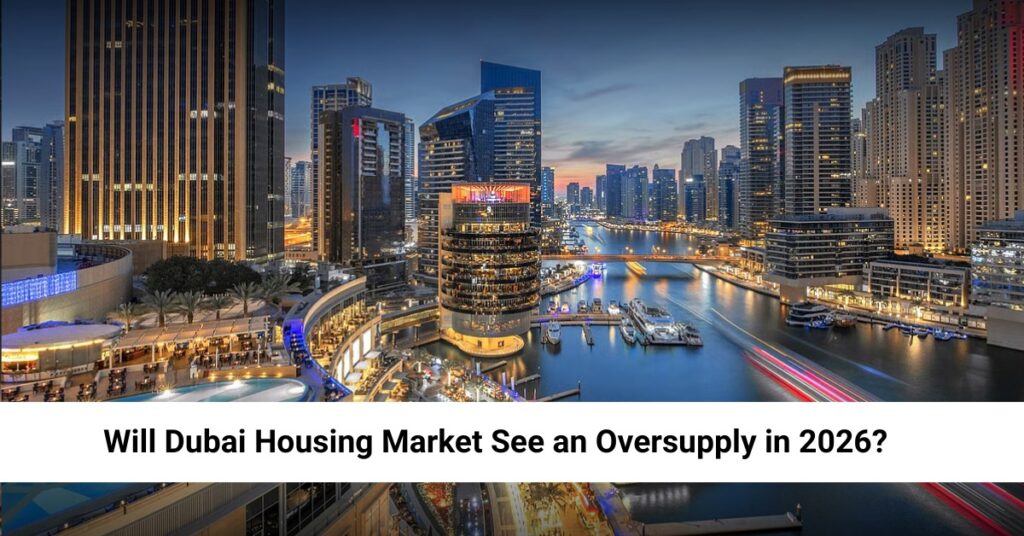
The residential property market in Dubai has provided superior growth in the last couple of years. Nonetheless, with the supply rising and the price rate levelling off, most of the investors are raising a critical question, Will Dubai experience a housing oversupply in 2026? The current statistics indicate that although some segments might experience pressure, the market overall can be supported by the strong fundamentals of demand.
Dubai Property Prices Continue to Rise
The residential market of Dubai has been projecting its price growth cycle up to 2025. Cushman and Wakefield predict a 13 percent year-on-year growth in property values in 2025. This is the 22 nd quarter of straight rise in prices.
Although the market is not recording the high returns and returns seen in 2023 and 2024, the market however is growing. The 2023 and 2024 prices have gone up by 22 percent and 18 percent respectively. The slow gains recently being normalizing and not depreciating. The buyers are witnessing a healthier sustainable growth stage as opposed to a hypothetical spike.
Supply Pipeline: How Much New Housing Is Coming?
As of 2025, the total residential inventory in Dubai was around 935000 units. The developers provided approximately 46,700 new houses in the year.
The market expects approximately:
- 55,000 units in 2026
- 75,000 units in 2027
In 2026-2030, over 400,000 units will be either under construction or planning. Developers might not however supply all these units on time. The actual completions will be slow because of the contractor capacity, the supply chain constraints and also the phased launches, with the actual completions numbering above 400,000 units by 2026-2030 yet to be built or under planning.
These units may however not be delivered on time by their developers. The actual completions will most likely be slowed down by the contractor capacity, supply chain constraints, and staged launches. This means the headline supply numbers may look large, but real delivery rates could remain controlled.
Population Growth Supports Demand
The number of people flowing in to Dubai is high. The emirate had over 208,000 new residents in the past one year only and it indicates a population growth of 5.2 percent. This is an increased growth rate compared to the percentage of projections as provided in the Dubai 2040 Urban Master Plan. The growth in economy, employment and world attractiveness of the city are still attracting professionals, business and those with high net worth.
Additionally, latent demand exists. Dubai Statistics Centre reports that 1.68 million people commuted or stayed temporarily in Dubai during peak periods in 2024. Many of these individuals could transition into permanent residents. Population growth remains one of the strongest buffers against oversupply.
Demand Is Now End-User Driven
Unlike previous cycles dominated by speculation, today’s market shows stronger end-user participation. Rental registrations increased by 7 percent year-on-year. Tenants renewed contracts at higher rates instead of relocating, even as rents increased.
Average residential rents rose 6 percent in 2025, reaching approximately Dh122 per square foot annually. Meanwhile, average sale prices climbed to Dh1,911 per square foot. Private school enrolments also increased by 6 percent. This signals long-term family settlement rather than short-term investor flipping.
Oversupply Risk: Where Could It Appear?
Oversupply concerns do not apply equally across all property types.
Nearly 45 percent of under-construction units are concentrated in:
- JVC and JVT
- Dubai South
- MBR City
- Business Bay
- Dubailand Residence Complex
Approximately 66 percent of future units will be studios and one-bedroom houses. The percentage of apartment development is over 86 percent. Conversely, the current housing mix comprises of around 80 percent apartment and 20 percent villas. This disequilibrium implies that smaller parts of apartments will be exposed to competitive forces. However, villa and townhouse supply remains relatively limited.
Villas Continue to Outperform Apartments
According to Knight Frank, the residential market in Dubai is shifting to the stability but not correction. There is a lack of supply of prime and family-oriented housing. Villas and townhouses are still performing better than apartments in terms of price appreciation and rental increment.
The demand is driven by high-net-worth and expatriate families that move into Dubai. Pricing is also supported by limited availability of land and slower construction of the villas. This trend suggests to the investors the significance of selecting assets instead of market timing in general.
Transaction Activity Remains Strong
CBRE reports that Dubai had registered one of the best years in terms of residential transactions in 2025.Investor and end-user demand was also strong and not deterred by the increase in prices. High absorption rates remain that of offsetting new supply.
Approximately 72 percent of all transactions were off-plan. Consumers prefer more price packages and options in payment. The growth in off-plan sales was approximately 30 percent per year. On the other hand, transactions in the secondary market increased by 8 percent in part contributed by the pricing disparity between the sellers and buyers.
Major Developers Lead the Market
Large, established developers continue to dominate activity. Damac led off-plan transactions with an 11.4 percent market share in 2025. Emaar and Binghatti followed closely.
In the resale market, Emaar accounted for around 16 percent of transactions. Strong brand recognition and completed community infrastructure support liquidity. Many developers, including Emaar, Ellington, Azizi, and Arada, now internalize construction operations to control costs and delivery timelines. This strategy may reduce sudden supply surges.
So, Will Dubai Face Oversupply in 2026?
The evidence suggests that Dubai will not face a market-wide housing oversupply in 2026.
Instead, the market will likely experience:
- Segment-specific pressure in smaller apartment categories
- Continued strength in villas and family homes
- Stabilizing price growth rather than sharp correction
- Controlled delivery due to execution constraints
The development of the population, economic growth, and ongoing activity of transactions give good support in the city of Dubai. Location, reputation of the developer and type of property should be considered by investors instead of headlines of over supply in general.
Final Thoughts for Property Buyers and Investors
The residential market of Dubai is no longer experience the breakneck pace of growth but a level maturity. This change is an indication of a strong, not a weak, person.
Although the supply is on the rise in the next few years, the drivers of demand stand firm. Even when buyers select a high quality asset in a desirable community, there is still an opportunity to gain growth over the long-run. When investing in Dubai real estate in 2026, it is recommended to assess the micro-markets well and focus on the long-term fundamentals rather than speculation. The market is not collapsing, It is evolving.