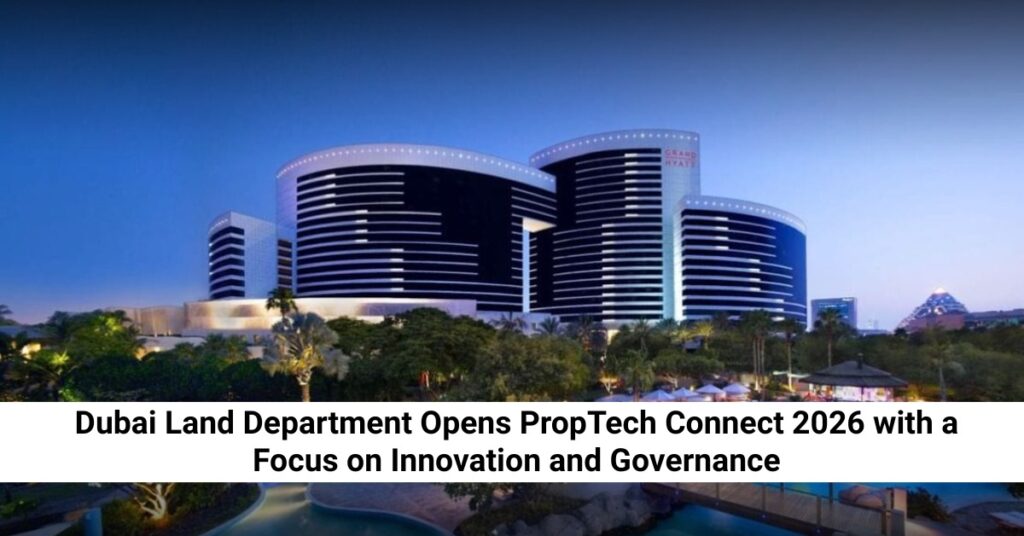
The path ahead for real estate investing unfolds in clear terms. Instead of jargon, there is clarity – built step by step. Through focused dialogue, new directions emerge naturally. Noteworthy ideas surface without fanfare. With steady input, the event gains depth that others miss. Behind each session lies careful thought about what comes next
Wednesday sees the start of PropTech Connect Middle East 2026, run by the Dubai Land Department. This move lines up with Dubai’s long-term economic goals and national tech ambitions. A clear signal emerges – Dubai is shaping how property works in the digital age. Leadership vision guides it, yet progress shows through action more than words. Behind every session lies alignment with D33 and the 2033 real estate roadmap. Not just talk, but steps forward begin now.
Out front stood top officials when things kicked off, joined by key planners, big-name builders, fund backers, and major tech firms from around the world, focused on property. This gathering highlighted howthe Dubai Land Department shapes rules that pull together the real estate scene, preparing it quietly for what comes next.
Starting things off, Matthew Maltzoff took the stage, speaking as head of PropTech Connect. His opening remarks made one thing clear right away – the network pulls together key players from different corners of industry and finance. Though each comes from a separate path, they meet on common ground: reshaping how buildings and cities evolve using modern tools. Instead of vague promises, it focuses on real collaborations that deepen investor value while paving the way into unexplored markets.
Not waiting for others to start, he urged everyone to jump into conversations with real input, so insights could move fast and turn thoughts into steps – steps that slowly but surely push forward the biggest part of the global economy.
Innovation That Builds Lasting Economic Value
Right off the bat, Majed Al Marri took the stage during the central part of the gathering. As head of the Real Estate Registration Sector at Dubai Land Department, he spoke with clear conviction. Hosting the region’s first tech-focused property conference signaled a deliberate direction. This move aligns with the broader vision of His Highness Sheikh Mohammed bin Rashid Al Maktoum, Vice President and Prime Minister of the UAE and Ruler of Dubai, whose leadership continues to shape the emirate’s long-term trajectory.
Technology in real estate is not treated as a passing trend. It is viewed as foundational infrastructure. The goal is not simply to keep pace, but to move early and decisively, drawing global attention through thoughtful, well-timed action. Dubai’s role as an innovation hub is built intentionally, with each step reinforcing its relevance where property and digital systems intersect.
Dubai Land Department Leadership Alignment and Long-Term Strategy
The discussion also referenced guidance from His Highness Sheikh Hamdan bin Mohammed bin Rashid Al Maktoum, whose leadership across Dubai and the UAE plays a key role in shaping outcomes. Strategic priorities consistently link back to the Dubai Economic Agenda D33 and the Dubai Real Estate Strategy 2033.
At the center of this effort is the Dubai PropTech Hub. Designed to translate new ideas into measurable economic value, the initiative leans heavily on digital transformation, including smart systems supported by machine learning. The focus is on practical impact rather than experimentation for its own sake.
Agreements to support real estate partnerships and innovation
Behind the main events at the gathering, a deal unfolded between the Dubai Land Department and the city’s economy and tourism office. Eight handshake-style papers joined forces with housing builders. This move backs those buying homes for the first time. Working together across government and business is now stronger because of it. Digital tools are rolling out faster than before. Smoother operations come into view for property markets. Clearer processes take shape behind the scenes. People putting money into properties feel the shift. Customers notice things running better. Each step ties back to these new understandings.
Samana Developers kicked things off, followed by Arada Developments stepping in next. After that came IRTH Signature Developments, joining the line. Reportage Prime Properties showed up in the middle part. Qube Development entered not long after. Then Manam Realty made its move into the group. Sky View Developments appeared near the end. Last of all, 4Direction Development closed it out.
Starting off, the Dubai Land Department teamed up with Equitativa Dubai through a new memorandum of understanding. This step kicks off an international push focused on real estate investment funds. Instead of just local efforts, attention now shifts toward broader visibility overseas. With this move, Dubai strengthens its role in global property investing circles. Behind it all lies a goal – shaping rules and systems that let these funds grow steadily. Everything aligns quietly with wider national strategies set by the UAE.
Improving Governance and Procedures Through Workshop
That morning kicked off with a session pairing Mohammed Yehia, who leads Real Estate Transactions at DLD, alongside Maryam Karmostaji, overseeing Jointly Owned Property Regulation there – guided through by Karim Hilal, founder and chief of ProTenders. Technology took center stage, along with how rules are set and decisions made using data, all framed around what comes next for property in Dubai.
Mohammed Yehya spoke about what matters most in Dubai’s property scene right now – keeping trust strong among investors, running things more smoothly, while building lasting worth over time. Quality takes the lead these days, since builders aim for modern spaces shaped by actual needs, green benchmarks, alongside intelligent systems woven into design. Meanwhile, those putting money into projects look closely at openness in dealings, clear rules set by authorities, plus steady gains despite worldwide pressures pulling in different directions.
After the event, Mohammed Yehia made clear that businesses aiming to operate or grow in Dubai’s property sector can reach out directly via channels set up by the Dubai Land Department. While speaking about access routes, he pointed to support tools like formal portals, advisory units, alliance systems, and active industry drives run under department oversight. Because coordination matters just as much as entry, his remarks included a nudge toward working alongside key hubs such as DIFC and Dubai Silicon Oasis. Since progress often follows collaboration, tying into these nodes could help form cohesive structures focused on long-term advancement, fresh ideas, and capital movement.
Dubai Land Department Joint Ownership of Property in Dubai
Maryam Karmostaji opened by walking through how shared property works in Dubai’s real estate scene. Instead of full private control, people who buy units also share responsibility for hallways, pools, gyms – those parts everyone uses. This setup shows up in homes and buildings meant for both living and working. Rules for these spaces come straight from the Dubai Land Department, keeping things on track. Ownership lines are drawn clearly; so are duties and decision-making roles. Because systems exist to monitor fairness, buyers gain confidence that their rights won’t be overlooked. Over time, these arrangements help keep shared features functioning well while preserving worth.
Dubai Land Department built a full system to handle shared property rules, putting clarity and fairness first. Not just outlining who does what among owners, their groups, and managers, but also making sure everyone answers for their actions. Backed by strict supervision, how fees are managed matters – directly shaping trust and stability across buildings. Digital tools now support these efforts, helping protect ownership stakes without slowing things down. Long-lasting success of joint properties ties closely to how well rules stick and adapt behind the scenes.
Dubai Land Department Future Focused Real Estate Workshops
One thing stood out at the event – sessions built around clear goals helping real estate grow, touching topics steering its current change. Not long after, a talk called ‘Building the Future: Dubai, Design, and the New Era of Real Estate’ shifted attention toward tech’s growing role, led by Masih Imtiaz, head of Imtiaz Developments. What once backed decisions now leads them; property technology has moved from the sidelines to the center stage. Cities take shape differently today, shaped less by tradition, more by digital tools guiding design, construction, and management. That shift isn’t coming – it is here, unfolding in how projects start, evolve, and run. Instead of just aiding progress, innovation drives it, redefining what buildings do and how they connect. Dubai’s path shows this clearly, where vision meets execution through smart systems woven into planning. From idea to operation, the process transforms, powered by data, responsiveness, and new ways of thinking. No longer an add-on, tech becomes the foundation, changing who builds, why, and with what outcome. Yet people remain central – the tools serve ambition, not replace it.
Out here, where numbers shape moves, one talk showed how facts once used just for summaries now speed up choices, giving firms an edge. Instead of waiting weeks, decisions happen fast because insights come quicker than before. Another conversation turned toward people – those who live and work in buildings – pointing out that their wants have changed. Hospitality ideas are slipping into spaces, mixing with online tools and seamless links between devices. These touches aren’t small; they lift lease renewals, keep tenants around longer, and boost asset value over time. When places feel alive, users stay. That sticks. Value builds slowly, but it stays.
Changing How Real Estate Investments Work Around the World
What if money moves could tell a story? This one did. Flowing out from the Middle East, it is touching buildings and blocks far beyond home borders. Big shifts start quietly – through choices made in boardrooms where long-term bets are placed without fanfare. Instead of chasing trends, some investors here reshape them. Money travels. Cities adapt. A talk called The Dominance of Capital Flows captured that motion. Not hype, just facts on how regional funds now influence what gets built, bought, or left behind worldwide.
During portfolio management discussions, the talk called “Tech-Driven Asset Management” looked at ways artificial intelligence is becoming a real-world aid – shifting how teams boost building profits while raising tenant levels along with smoothing out upkeep and power use.
Tomorrow’s big builds need fresh thinking, right from early sketches to daily running. Tools matter, sure, but so do who you work with and how decisions flow. Getting ideas out of small tests and into real action takes smart moves. Speed grows when teams align on purpose, not just process. Real progress shows up when effort sticks beyond the first trial.
A fresh day ended with a talk called ‘Building Smart at Scale: Embedding Technology and Sustainability in the Middle East’s Mega Projects.’ From the first meeting, tech and green thinking must shape big builds. Early choices affect how well things run later. Safety grows when systems are designed right from the start. Performance stays strong if plans include adaptability. Readiness for operation links closely to early-stage decisions. Big efforts depend on these factors, especially across vast developments.
A Platform Linking Change With Rules, Ideas, and Money
Now entering its next phase, the event draws over four thousand attendees alongside fifteen hundred firms focused on property tech. Driving force behind PropTech Connect Middle East 2026 comes from the Dubai Land Department, shaping a space where rules meet new ideas and capital flow. Built on strong institutions, it moves ahead with purpose, guided by long-term thinking. Growth stays steady because of how systems adapt, helping Dubai stand out locally and worldwide.