

Last updated: July 2026
A single person in Dubai usually spends between AED 6,000 and 13,000 each month, depending on their lifestyle and where they live. For a family of four, monthly costs typically range from AED 17,000 to 35,000, covering rent, school fees, and utilities. Housing is the biggest expense. Living in Downtown Dubai or Dubai Marina can cost 40 to 60 percent more than similar areas like JVC or Dubai Silicon Oasis.
Overview: What Does It Really Cost to Live in Dubai?
Your cost of living in Dubai mainly depends on where you live, if your children go to private school, and if you own a car. Carefully planning these choices helps you manage your budget, while ignoring them can lead to financial stress.
Dubai does not charge personal income, capital gains, or property tax, which can make living costs seem lower. However, you still need to budget for private health insurance, private school fees (since public schools are taught in Arabic and are rarely used by expats), and rent, which is often paid in one to four large payments rather than monthly.
This guide is for people moving to Dubai who need clear monthly expense estimates for salary talks, investors and buyers comparing living and ownership costs, and current residents checking their budgets. It covers all major expenses, like housing, utilities, food, transport, healthcare, education, and hidden costs, with up-to-date AED and USD figures. Instead of giving just one average, the guide shows how your personal choices affect your costs.
Key point: There is no single ‘cost of living in Dubai.’ Your expenses mainly depend on where you live, which school you choose, and how you get around. The next sections break down each of these factors in detail.
Quick Monthly Cost Summary
Excluding rent, a single person in Dubai typically spends AED 4,000 to 12,000 per month, while a family of four spends AED 17,000 to 35,000 per month. Including rent, a single person can expect to spend between AED 6,000 and AED 13,000 per month, while a family of four generally needs AED 20,000 to AED 45,000, depending on their location and school preferences.
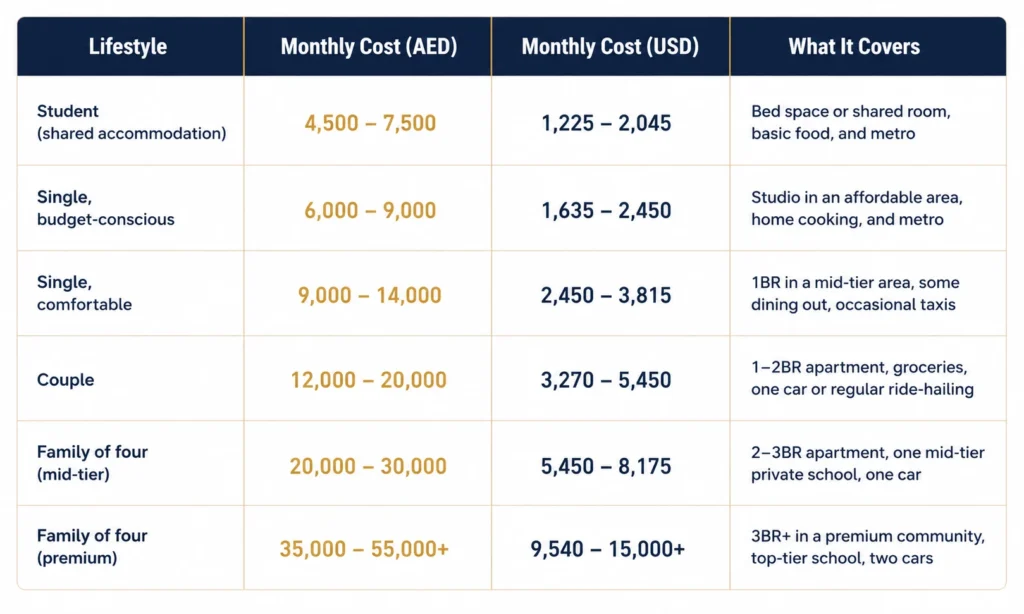
| Lifestyle | Monthly Cost (AED) | Monthly Cost (USD) | What It Covers |
| Student (shared accommodation) | 4,500 – 7,500 | 1,225 – 2,045 | Bed space or shared room, basic food, and metro |
| Single, budget-conscious | 6,000 – 9,000 | 1,635 – 2,450 | Studio in an affordable area, home cooking, and metro |
| Single, comfortable | 9,000 – 14,000 | 2,450 – 3,815 | 1BR in a mid-tier area, some dining out, occasional taxis |
| Couple | 12,000 – 20,000 | 3,270 – 5,450 | 1–2BR apartment, groceries, one car or regular ride-hailing |
| Family of four (mid-tier) | 20,000 – 30,000 | 5,450 – 8,175 | 2–3BR apartment, one mid-tier private school, one car |
| Family of four (premium) | 35,000 – 55,000+ | 9,540 – 15,000+ | 3BR+ in a premium community, top-tier school, two cars |
These numbers come from Numbeo’s Dubai data (July 2026) and current rental and salary reports used in this guide. Be careful with single average figures, since actual costs can vary widely depending on the area and school level.
Can You Afford to Live in Dubai?
At the lowest end, AED 6,000 to 7,000 per month (excluding rent) covers basic needs such as shared housing, groceries, and public transport. For comfortable, independent living, you usually need AED 12,000-15,000 per month. Living alone on less than AED 5,000 is only possible if your employer provides housing or you share a room or bed space. Even in cheaper areas, a studio costs about AED 3,500 to 4,000 per month, which takes up most of your budget before food, transport, or insurance. People on this budget say it’s possible to get by, but it’s not comfortable and usually means cooking all meals, not owning a car, and saving very little.
Medium Budget: AED 10,000–18,000/month
This budget allows for independent living, including a studio or one-bedroom apartment in JVC, Dubai Silicon Oasis, or similar areas. It covers regular groceries, occasional dining out, use of the metro or ride-hailing services, and some savings. Most single professionals who enjoy living in Dubai fall within this range.
High Budget: AED 20,000+/month
With this budget, you can rent a one- or two-bedroom apartment in a premium waterfront or downtown area, own a car, dine out frequently, and save a substantial amount. Families with children in private schools typically require at least this level of income due to school fees.
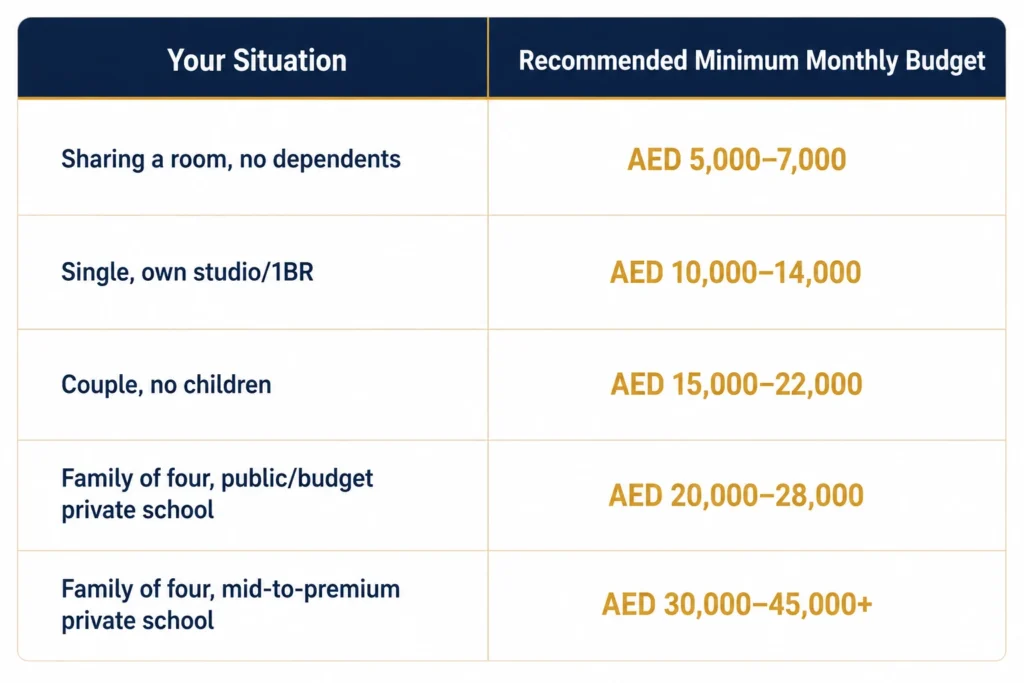
| Your Situation | Recommended Minimum Monthly Budget |
| Sharing a room, no dependents | AED 5,000–7,000 |
| Single, own studio/1BR | AED 10,000–14,000 |
| Couple, no children | AED 15,000–22,000 |
| Family of four, public/budget private school | AED 20,000–28,000 |
| Family of four, mid-to-premium private school | AED 30,000–45,000+ |
Expert tip: Many newcomers don’t realize that rent in Dubai is usually paid in one to four big payments each year, not monthly. Some landlords let you pay in more installments for a fee. Still, you should be ready to pay 25 to 100 percent of the yearly rent upfront, plus a security deposit and agency fee (see the Hidden Costs section for more details).
Average Cost of Living in Dubai by Lifestyle
A single person usually spends AED 4,000 to 13,000 per month. Couples spend AED 9,000 to 20,000, and a family of four spends AED 17,000 to 45,000. Students who share accommodation spend AED 4,500 to 7,500, while remote workers without employer-provided housing generally need AED 10,000 to 16,000 for comfortable, independent living.
Single Person
A single professional usually spends about 30% of their budget on housing, 15% on transport, and 15% on food. This percentage may vary depending on lifestyle and residential area. The rest goes to utilities, insurance, and other costs. Most say AED 10,000 to 15,000 per month is enough for a ‘decent, not luxurious’ lifestyle, with a private studio, some dining out, using ride-hailing or the metro, and some savings. Budgets under AED 8,000 usually mean sharing accommodation.
Couple
Sharing rent and utilities helps couples save money. A couple renting a one-bedroom in a mid-range area, cooking most meals at home, and using the metro or one car usually spends AED 12,000 to 18,000 per month. This is less than double what a single person pays, since housing costs don’t rise as much as the number of people does. For families, the highest costs are the size of the home (a 2–to 3-bedroom apartment or villa) and school fees, which can range from AED 12,500 to over AED 100,000 per child per year, depending on the school. A family choosing a mid-range British or Indian school, a 2–3-bedroom home in an affordable area, and one car usually needs AED 25,000-35,000 per month. Picking a top international school or a waterfront home can push this up to AED 45,000 or more.
Remote Worker / Digital Nomad
Remote workers on the UAE’s dedicated remote work visa (for those earning at least $3,500 per month from a non-UAE employer) are typically responsible for their own housing costs. Co-working memberships (AED 500–1,500 per month) and reliable home internet are essential additional expenses, bringing the comfortable remote work budget to approximately AED 12,000–18,000 per month.
Student
Students typically share accommodation, such as a bed space or shared room, reducing rent to AED 1,500 to 3,000 per month. Including basic groceries, a student Nol card, and minimal entertainment, most students budget AED 4,500 to 7,500 per month. This amount increases if the university does not offer subsidized housing.
Key takeaway: The expense ranges above assume you have chosen your area of residence and, for families, your school tier appropriately. Poor decisions in these areas can increase costs by 30–50%.
Monthly Cost Breakdown
Housing typically accounts for 30–40% of a Dubai budget, making it the largest expense, followed by food (15–20% for groceries and dining), transport (8–12%), and utilities (5–8%). Healthcare and education are often underestimated because they are billed annually rather than monthly.
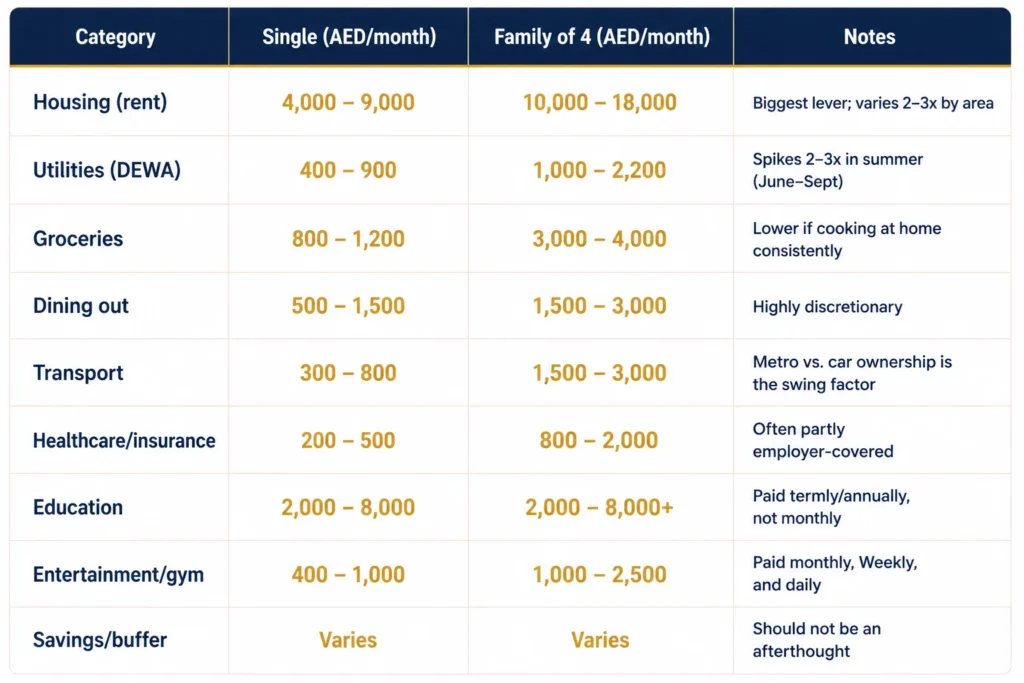
| Category | Single (AED/month) | Family of 4 (AED/month) | Notes |
| Housing (rent) | 4,000 – 9,000 | 10,000 – 18,000 | Biggest lever; varies 2–3x by area |
| Utilities (DEWA) | 400 – 900 | 1,000 – 2,200 | Spikes 2–3x in summer (June–Sept) |
| Groceries | 800 – 1,200 | 3,000 – 4,000 | Lower if cooking at home consistently |
| Dining out | 500 – 1,500 | 1,500 – 3,000 | Highly discretionary |
| Transport | 300 – 800 | 1,500 – 3,000 | Metro vs. car ownership is the swing factor |
| Healthcare/insurance | 200 – 500 | 800 – 2,000 | Often partly employer-covered |
| Education | 2,000 – 8,000 | 2,000 – 8,000+ | Paid termly/annually, not monthly |
| Entertainment/gym | 400 – 1,000 | 1,000 – 2,500 | Paid monthly, Weekly, and daily |
| Savings/buffer | Varies | Varies | Should not be an afterthought |
Practical example: A single professional earning AED 14,000/month in JVC, renting a 1-bedroom at AED 5,500/month, spends roughly: rent 5,500, DEWA 550, groceries 1,000, dining 800, transport 400 (metro), insurance 300, entertainment 600, a total of about AED 9,150, leaving nearly AED 4,850 for savings, discretionary spending, or debt repayment. That savings margin narrows quickly if the same person instead rents a comparable unit in Dubai Marina at AED 9,000/month.
Accommodation Costs in Dubai
Monthly rent in 2026 typically ranges from AED 3,500–6,000 for a studio, AED 4,500–9,500 for a 1-bedroom, AED 7,500–15,000 for a 2-bedroom, and AED 12,000–25,000+ for a 3-bedroom or larger, with the low end representing affordable communities like JVC or Dubai Silicon Oasis and the high end representing Downtown Dubai, Dubai Marina, or Palm Jumeirah.
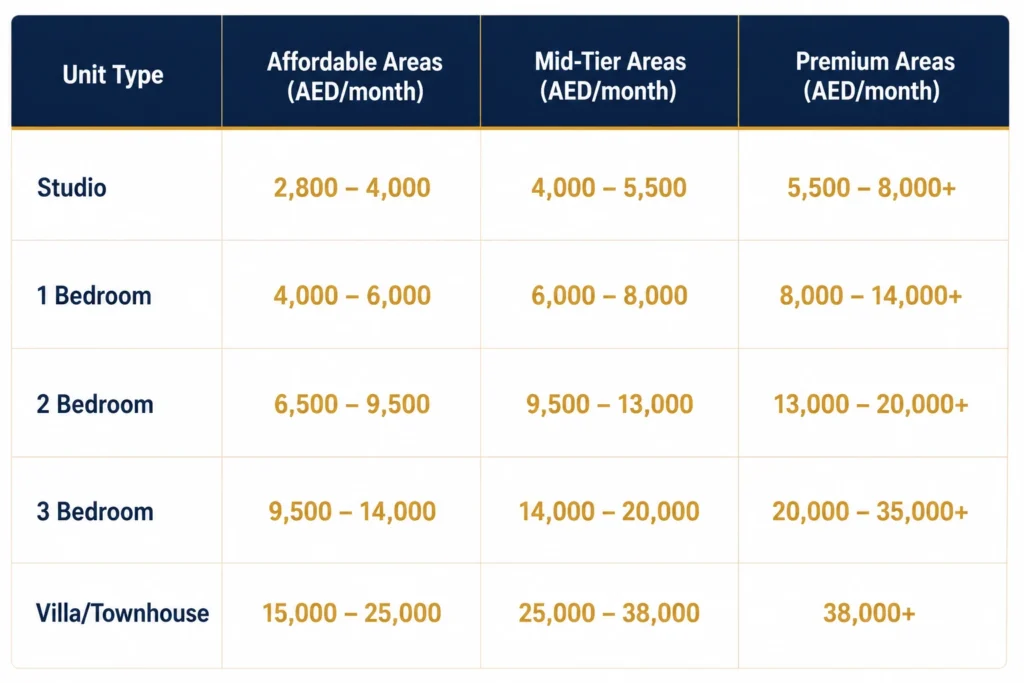
| Unit Type | Affordable Areas (AED/month) | Mid-Tier Areas (AED/month) | Premium Areas (AED/month) |
| Studio | 2,800 – 4,000 | 4,000 – 5,500 | 5,500 – 8,000+ |
| 1 Bedroom | 4,000 – 6,000 | 6,000 – 8,000 | 8,000 – 14,000+ |
| 2 Bedroom | 6,500 – 9,500 | 9,500 – 13,000 | 13,000 – 20,000+ |
| 3 Bedroom | 9,500 – 14,000 | 14,000 – 20,000 | 20,000 – 35,000+ |
| Villa/Townhouse | 15,000 – 25,000 | 25,000 – 38,000 | 38,000+ |
Ranges synthesize current Numbeo crowd-sourced data, area-specific market reports, and typical annual-to-monthly rent conversions. Actual asking rents vary with building age, view, and furnishing status. Always confirm current listings for specific projects, rather than relying on averages alone, when comparing buying versus renting.
Expert insight: If you’re deciding between renting and buying at these price points, it’s worth running the numbers both ways. In several JVC and Dubai South projects, a monthly payment on an off-plan 1-bedroom under a developer payment plan can land close to what you’d pay in rent for a comparable unit, without the annual rent cheque cash-flow squeeze. Our investment guide walks through that comparison in more detail.
Best Affordable Areas in Dubai
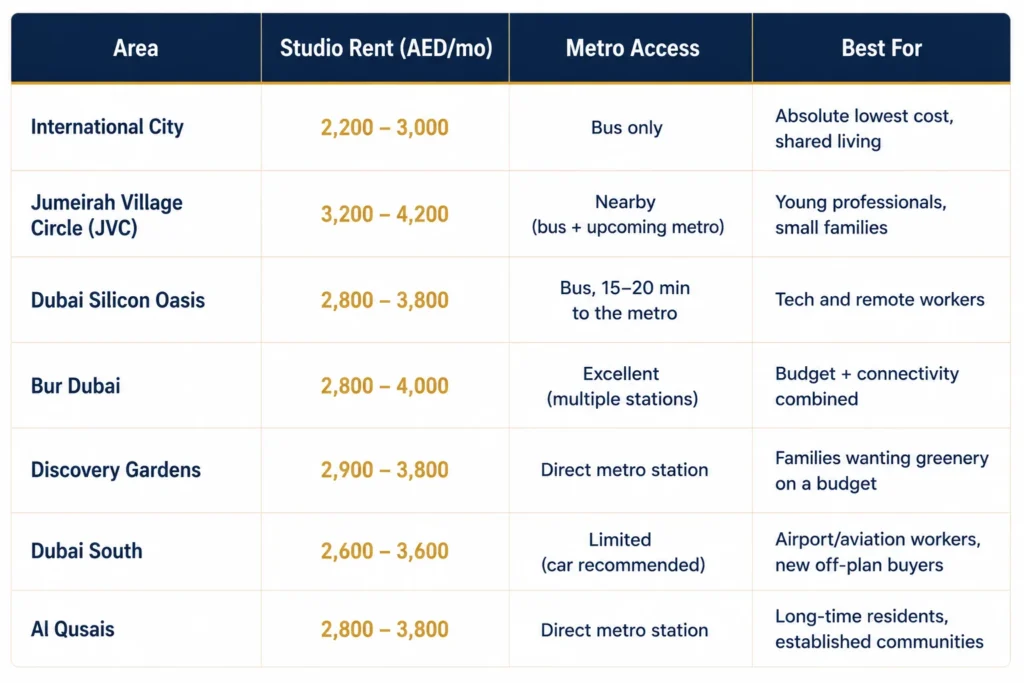
International City, Jumeirah Village Circle (JVC), Dubai Silicon Oasis, Bur Dubai, Discovery Gardens, Dubai South, and Al Qusais consistently offer the lowest rents in Dubai while still providing bus or metro access, making them the default choice for budget-conscious singles, students, and families.
| Area | Studio Rent (AED/mo) | Metro Access | Best For |
| International City | 2,200 – 3,000 | Bus only | Absolute lowest cost, shared living |
| Jumeirah Village Circle (JVC) | 3,200 – 4,200 | Nearby (bus + upcoming metro) | Young professionals, small families |
| Dubai Silicon Oasis | 2,800 – 3,800 | Bus, 15–20 min to the metro | Tech and remote workers |
| Bur Dubai | 2,800 – 4,000 | Excellent (multiple stations) | Budget + connectivity combined |
| Discovery Gardens | 2,900 – 3,800 | Direct metro station | Families wanting greenery on a budget |
| Dubai South | 2,600 – 3,600 | Limited (car recommended) | Airport/aviation workers, new off-plan buyers |
| Al Qusais | 2,800 – 3,800 | Direct metro station | Long-time residents, established communities |
Pros of these areas: significantly lower rent (often 30–50% below Downtown or Marina equivalents), generally lower service charges, and, for JVC, Bur Dubai, Discovery Gardens, and Al Qusais specifically, genuinely usable public transport.
Cons: fewer walkable dining and retail options, older building stock in some cases (International City, parts of Bur Dubai), and longer commutes to Downtown, DIFC, or Marina-based jobs if you’re not near a metro line.
Who should choose this: students, remote workers, first-time buyers prioritizing yield over lifestyle, and families who value space and a lower cost base over central-Dubai convenience.
Premium Areas in Dubai
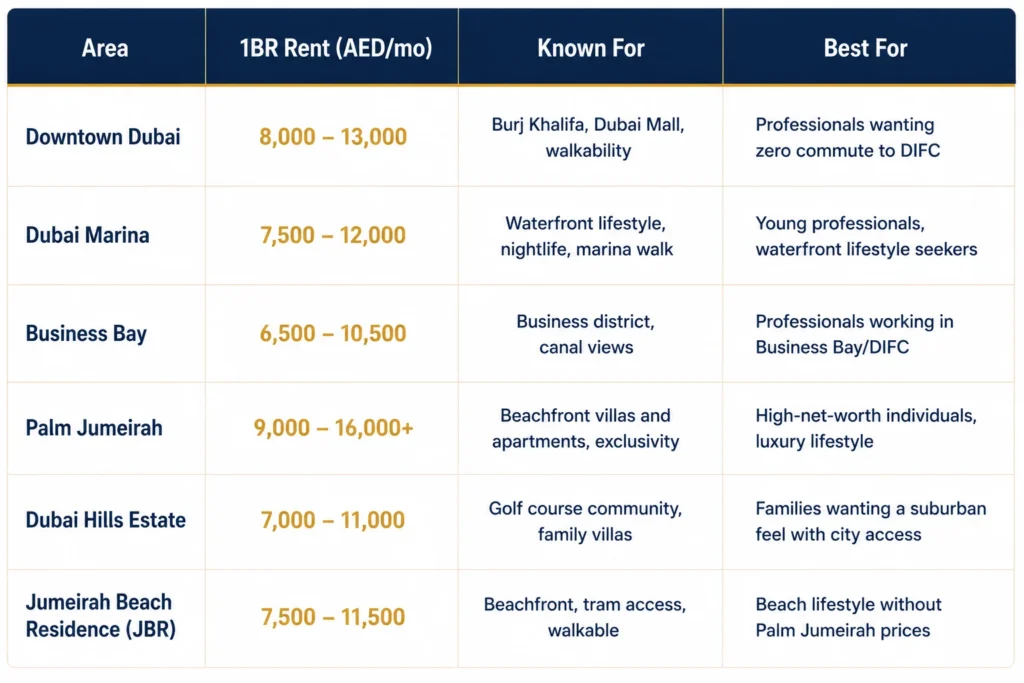
Downtown Dubai, Dubai Marina, Business Bay, Palm Jumeirah, Dubai Hills Estate, and JBR command the highest rents in the city, typically 60–120% above affordable-area equivalents, in exchange for walkability, waterfront or skyline views, and proximity to Dubai’s main business districts.
| Area | 1BR Rent (AED/mo) | Known For | Best For |
| Downtown Dubai | 8,000 – 13,000 | Burj Khalifa, Dubai Mall, walkability | Professionals wanting zero commute to DIFC |
| Dubai Marina | 7,500 – 12,000 | Waterfront lifestyle, nightlife, marina walk | Young professionals, waterfront lifestyle seekers |
| Business Bay | 6,500 – 10,500 | Business district, canal views | Professionals working in Business Bay/DIFC |
| Palm Jumeirah | 9,000 – 16,000+ | Beachfront villas and apartments, exclusivity | High-net-worth individuals, luxury lifestyle |
| Dubai Hills Estate | 7,000 – 11,000 | Golf course community, family villas | Families wanting a suburban feel with city access |
| Jumeirah Beach Residence (JBR) | 7,500 – 11,500 | Beachfront, tram access, walkable | Beach lifestyle without Palm Jumeirah prices |
Why these areas command a premium: it comes down to limited waterfront or central-location supply, strong end-user and rental demand from professionals working nearby, and, for Downtown, Marina, and JBR specifically, genuine walkability that removes the need for a car, which many residents value enough to pay a substantial rent premium for.
Who should avoid this tier: students, budget-conscious singles, and anyone for whom the rent premium isn’t buying a lifestyle or commute benefit they’ll actually use. Paying Marina prices while working from home, for instance, captures little of what makes the premium worth it.
Utility Costs in Dubai (DEWA)
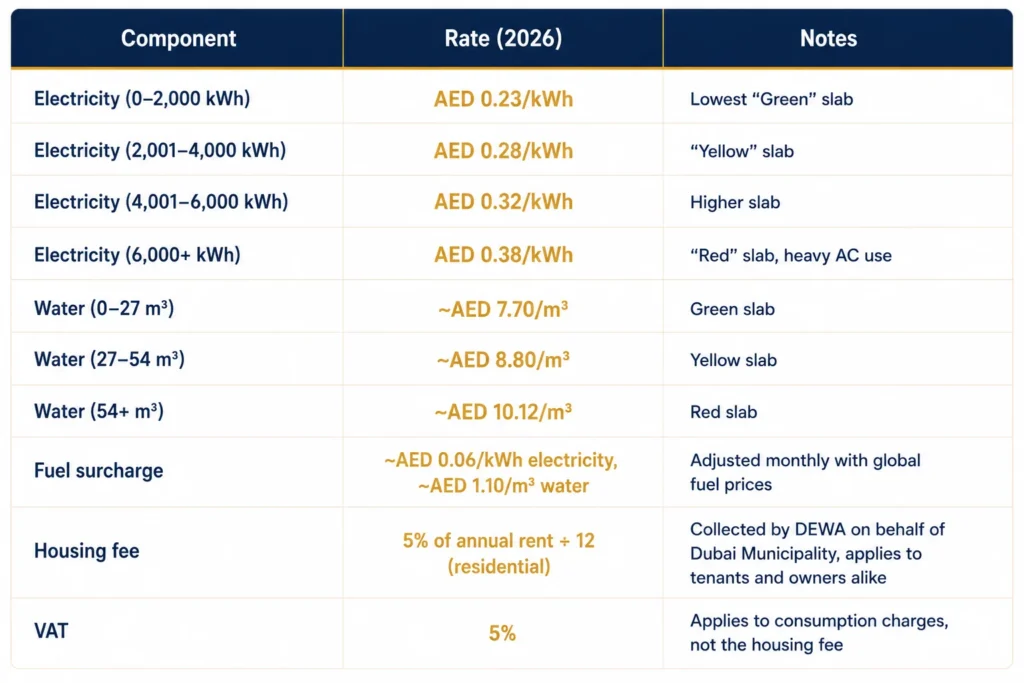
A typical 1-bedroom apartment’s DEWA bill (electricity, water, and municipality fees combined) runs AED 400–600/month in winter and AED 700–1,100/month in summer, when air conditioning drives 60–70% of total electricity use. A 3-bedroom villa can see summer bills of AED 2,500–5,000+.
Dubai Electricity and Water Authority (DEWA) bills combine several distinct charges, and understanding each one explains why two households with identical rent can have very different utility bills:
| Component | Rate (2026) | Notes |
| Electricity (0–2,000 kWh) | AED 0.23/kWh | Lowest “Green” slab |
| Electricity (2,001–4,000 kWh) | AED 0.28/kWh | “Yellow” slab |
| Electricity (4,001–6,000 kWh) | AED 0.32/kWh | Higher slab |
| Electricity (6,000+ kWh) | AED 0.38/kWh | “Red” slab, heavy AC use |
| Water (0–27 m³) | ~AED 7.70/m³ | Green slab |
| Water (27–54 m³) | ~AED 8.80/m³ | Yellow slab |
| Water (54+ m³) | ~AED 10.12/m³ | Red slab |
| Fuel surcharge | ~AED 0.06/kWh electricity, ~AED 1.10/m³ water | Adjusted monthly with global fuel prices |
| Housing fee | 5% of annual rent ÷ 12 (residential) | Collected by DEWA on behalf of Dubai Municipality, applies to tenants and owners alike |
| VAT | 5% | Applies to consumption charges, not the housing fee |
Rates reflect DEWA’s published slab tariff structure as of mid-2026; the fuel surcharge specifically is republished monthly, so treat it as an approximate planning figure rather than a fixed rate.
Practical example:
A 1-bedroom apartment using 2,500 kWh of electricity and 20 m³ of water in a moderate month works out to roughly AED 600 in electricity slab charges (2,000 kWh × AED 0.23, plus 500 kWh × AED 0.28) and AED 154 in water charges (20 m³ × AED 7.70), before the fuel surcharge, sewerage fee, 5% VAT, and the housing fee (5% of annual rent ÷ 12) are added, landing close to the AED 400–600 winter estimate above once you account for the fact that most winter months see meaningfully lower consumption than this example. In peak summer, the same apartment’s electricity consumption often more than doubles as AC runs continuously, pushing the bill toward AED 900–1,200.
Expert insight:
The housing fee catches almost every newcomer off guard because it isn’t a utility charge at all; it’s a Dubai Municipality fee added to the DEWA bill, and it scales with your rent, not your consumption. A tenant paying AED 8,000/month rent pays roughly AED 400/month in housing fee alone (5% × AED 96,000 ÷ 12), regardless of how little electricity or water they use.
Money-saving tip:
Setting your thermostat to 24°C instead of lower, closing curtains during the day, and fixing dripping taps immediately are the three changes with the fastest payback. A single dripping tap can waste 500+ gallons a month, and each degree you lower the AC below 24°C measurably increases consumption.
Grocery Costs in Dubai
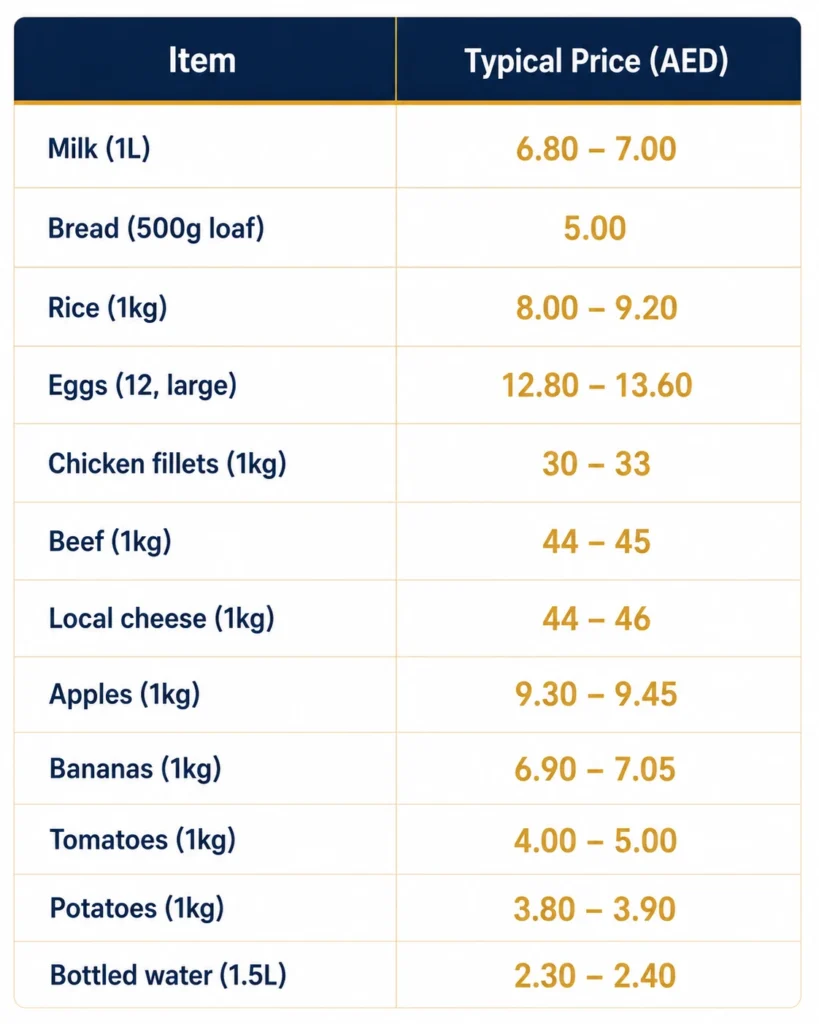
A single person cooking most meals at home spends roughly AED 800–1,200/month on groceries; a family of four spends AED 2,500–4,000/month. Fresh produce and locally available meat are relatively affordable, while imported specialty items carry a noticeable premium.
| Item | Typical Price (AED) |
| Milk (1L) | 6.80 – 7.00 |
| Bread (500g loaf) | 5.00 |
| Rice (1kg) | 8.00 – 9.20 |
| Eggs (12, large) | 12.80 – 13.60 |
| Chicken fillets (1kg) | 30 – 33 |
| Beef (1kg) | 44 – 45 |
| Local cheese (1kg) | 44 – 46 |
| Apples (1kg) | 9.30 – 9.45 |
| Bananas (1kg) | 6.90 – 7.05 |
| Tomatoes (1kg) | 4.00 – 5.00 |
| Potatoes (1kg) | 3.80 – 3.90 |
| Bottled water (1.5L) | 2.30 – 2.40 |
Figures reflect current crowd-sourced Numbeo pricing (July 2026). Hypermarkets like Carrefour, Lulu, and Spinneys tend to sit at the lower end of these ranges; smaller convenience stores and premium grocers like Waitrose sit noticeably higher.
Expert insight: The gap between a “cheap” and “expensive” Dubai grocery bill usually isn’t about which items you buy, it’s about which store. The same basket at Carrefour or Lulu Hypermarket can cost 20–30% less than the identical basket at a premium supermarket in a Downtown or Marina building, simply because retail space rent is built into the shelf price.
Restaurant Costs in Dubai
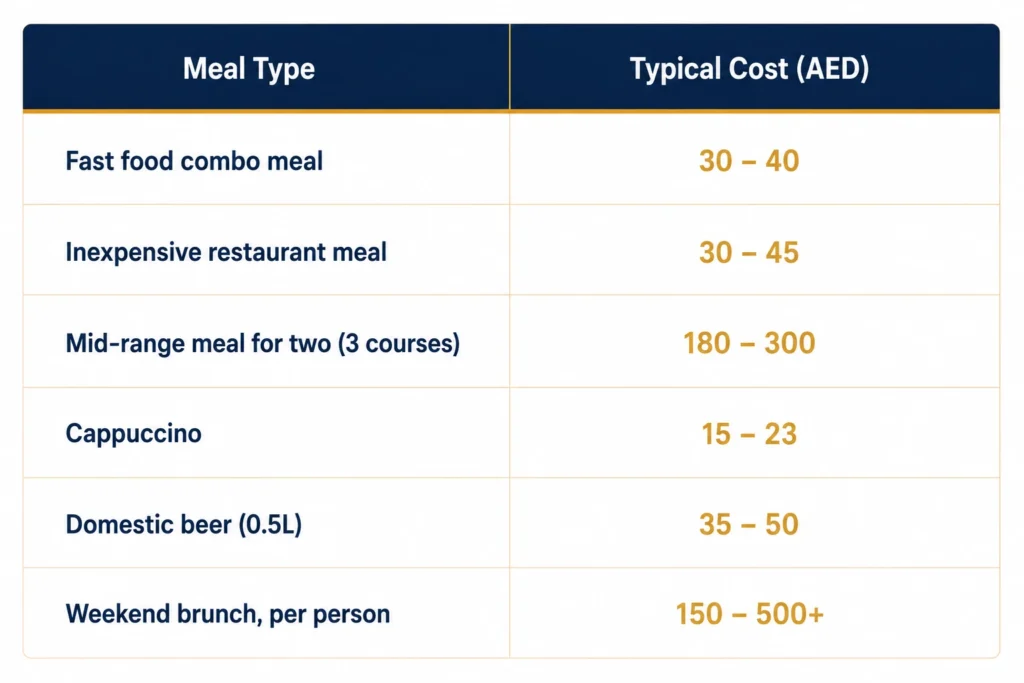
An inexpensive meal in Dubai costs roughly AED 30–45, a mid-range three-course meal for two runs AED 180–300, and a cup of coffee averages AED 15–23. Dubai’s famous weekend brunches, a major social institution, typically cost AED 150–500+ per person, depending on the venue and whether drinks are included.
| Meal Type | Typical Cost (AED) |
| Fast food combo meal | 30 – 40 |
| Inexpensive restaurant meal | 30 – 45 |
| Mid-range meal for two (3 courses) | 180 – 300 |
| Cappuccino | 15 – 23 |
| Domestic beer (0.5L) | 35 – 50 |
| Weekend brunch, per person | 150 – 500+ |
Practical example: Someone eating out for lunch 3 times a week at an inexpensive restaurant (roughly AED 35 average) and doing one mid-range dinner and one brunch a month spends approximately: (35 × 12 lunches) + (250 mid-range dinner) + (300 brunch) ≈ AED 970/month on dining out, consistent with the AED 800–1,200 dining range used in the cost breakdown table above for a moderately social single person.
Who should budget more here: Dubai’s social culture, especially among young professionals, revolves heavily around brunches and group dining. If that’s part of your lifestyle, budget AED 1,500–2,500/month for dining rather than the leaner AED 500–800 figure that fits someone who cooks most meals.
Transportation Costs in Dubai
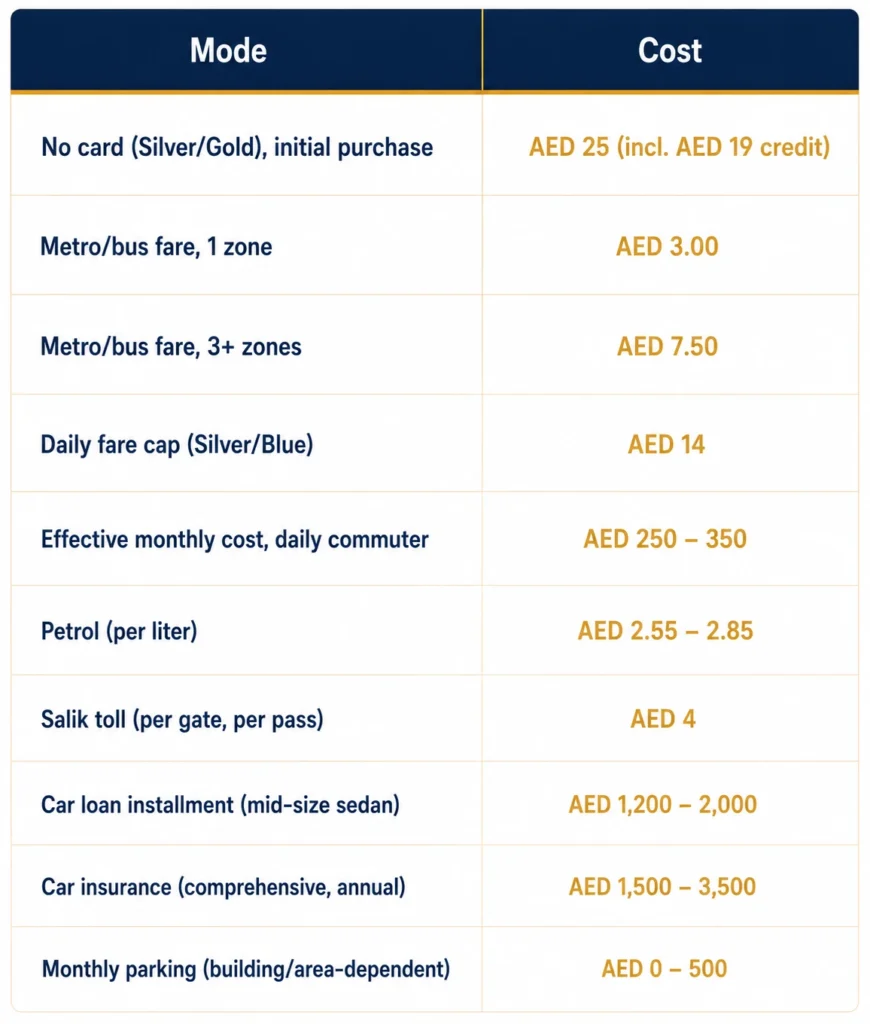
Dubai Metro fares run AED 3–7.50 per trip, depending on the zones crossed, capped at AED 14/day on a Silver Nol card, which works out to roughly AED 250–350/month for a daily commuter. Running a car instead typically costs AED 1,500–3,500+/month once loan installments, insurance, fuel, parking, and Salik toll charges are included.
| Mode | Cost |
| No card (Silver/Gold), initial purchase | AED 25 (incl. AED 19 credit) |
| Metro/bus fare, 1 zone | AED 3.00 |
| Metro/bus fare, 3+ zones | AED 7.50 |
| Daily fare cap (Silver/Blue) | AED 14 |
| Effective monthly cost, daily commuter | AED 250 – 350 |
| Petrol (per liter) | AED 2.55 – 2.85 |
| Salik toll (per gate, per pass) | AED 4 |
| Car loan installment (mid-size sedan) | AED 1,200 – 2,000 |
| Car insurance (comprehensive, annual) | AED 1,500 – 3,500 |
| Monthly parking (building/area-dependent) | AED 0 – 500 |
Metro fares reflect RTA’s current zone-based NOL tariff. The “effective monthly cost” for a regular commuter is calculated by applying the AED 14 daily cap over roughly 22 working days, which closely aligns with the flat monthly transport pass estimates cited in most cost-of-living surveys.
car vs. metro:
A car makes financial sense once you’re regularly traveling to areas the metro doesn’t reach well (Dubai Hills Estate, most villa communities, Dubai South) or traveling with family/cargo. For a single person commuting along the metro corridor (Marina–JLT–Business Bay–Downtown), the metro is dramatically cheaper, often AED 1,000–2,500/month cheaper than car ownership once insurance, fuel, and parking are included, and removes Dubai’s notorious peak-hour traffic from the equation entirely.
Practical example:
A professional who commutes daily between JVC and Business Bay via a metro/bus combination spends roughly AED 300/month on transport. The same commute by car, loan installment AED 1,500, insurance AED 200/month equivalent, fuel AED 400, parking AED 300, occasional Salik AED 100, runs closer to AED 2,500/month, a difference of over AED 2,000 every month, or roughly AED 26,000 a year.
Expert insight:
New arrivals almost always underestimate Salik. Dubai’s toll gates charge per pass, not per trip length, so a commute that crosses two or three Salik gates twice a day can add AED 500–800/month, which rarely shows up in early budget planning.
Healthcare Costs in Dubai
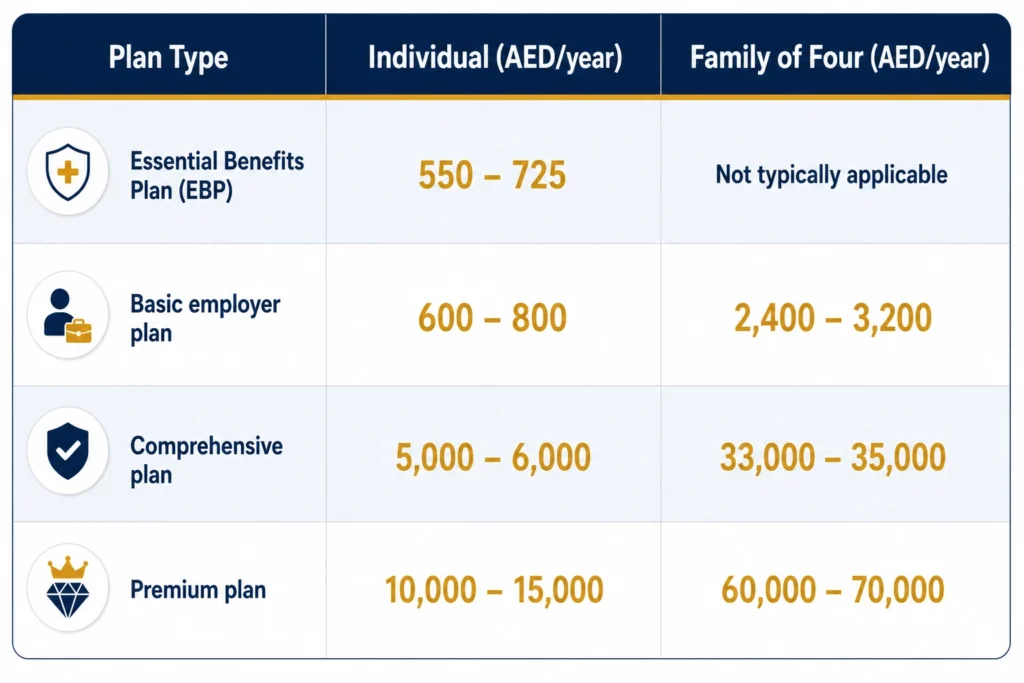
Health insurance is legally mandatory for every Dubai resident. Basic employer-sponsored plans cost employers roughly AED 600–800/year per employee, while comprehensive plans that cover pre-existing conditions, maternity, and dental typically run AED 5,000–15,000+/year if you’re buying privately rather than receiving it through an employer.
Dubai Health Authority regulations require every employer to provide health insurance to employees, and residents sponsoring family members must arrange coverage for their family members as well. For lower earners (under AED 4,000/month) or those without employer coverage, the government-mandated Essential Benefits Plan (EBP) provides baseline coverage at AED 550–725/year.
| Plan Type | Individual (AED/year) | Family of Four (AED/year) |
| Essential Benefits Plan (EBP) | 550 – 725 | Not typically applicable |
| Basic employer plan | 600 – 800 | 2,400 – 3,200 |
| Comprehensive plan | 5,000 – 6,000 | 33,000 – 35,000 |
| Premium plan | 10,000 – 15,000 | 60,000 – 70,000 |
Practical example: A single employee on a standard employer-sponsored basic plan pays little to nothing directly, since the employer typically covers the premium. A self-employed freelancer or remote worker without employer coverage buying a comprehensive individual plan privately should budget AED 400–500/month (AED 5,000–6,000/year) for reasonable coverage that includes outpatient visits, prescriptions, and hospitalization.
Expert insight: Don’t assume your employer’s “basic” plan is sufficient if you have dependents or a pre-existing condition. Basic plans frequently exclude maternity coverage, dental, and pre-existing condition treatment, all of which require an upgrade that the employee (not the employer) typically pays for out of pocket.
Education Costs in Dubai
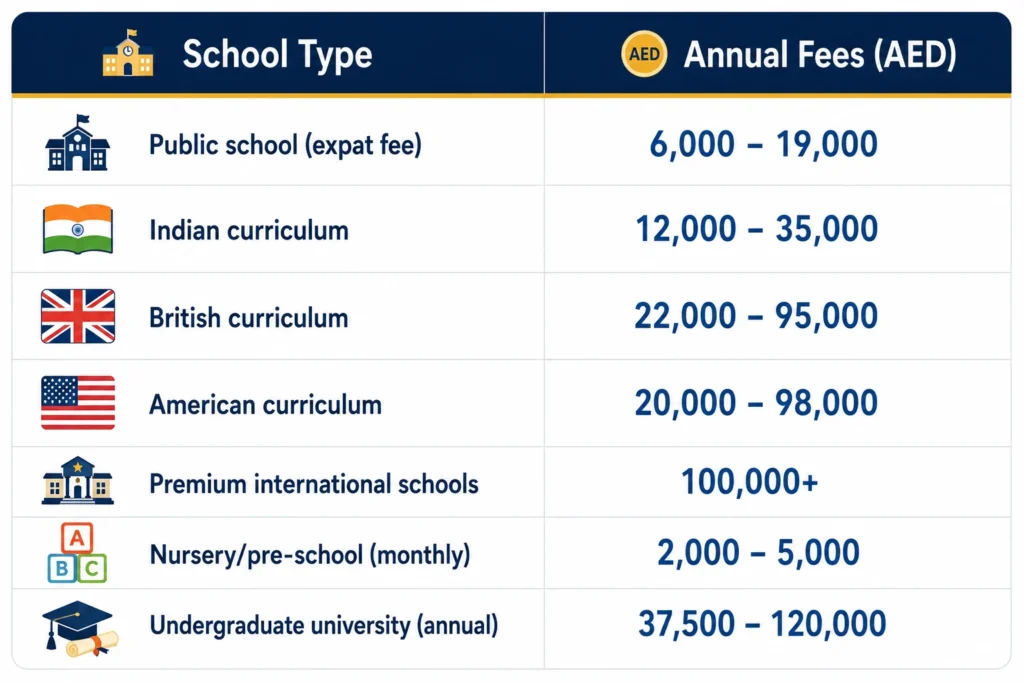
Private school fees in Dubai, the default choice for the vast majority of expat families, range from roughly AED 12,500/year at the budget end to AED 100,000+/year at premium international schools, with KHDA (Knowledge and Human Development Authority) capping annual fee increases to protect families from unpredictable jumps.
Public schools in Dubai are taught primarily in Arabic and follow the Emirati national curriculum, so most expat families choose private schools despite the added cost, valuing curriculum continuity if they relocate again internationally.
| School Type | Annual Fees (AED) |
| Public school (expat fee) | 6,000 – 19,000 |
| Indian curriculum | 12,000 – 35,000 |
| British curriculum | 22,000 – 95,000 |
| American curriculum | 20,000 – 98,000 |
| Premium international schools | 100,000+ |
| Nursery/pre-school (monthly) | 2,000 – 5,000 |
| Undergraduate university (annual) | 37,500 – 120,000 |
KHDA determines annual tuition fee caps through an Education Cost Index, meaning schools cannot raise fees arbitrarily year to year, a useful protection for families budgeting for multi-year school costs.
Practical example: A family with two children in a mid-tier British curriculum school (AED 35,000/child/year) pays AED 70,000/year in tuition alone, before uniforms, transport, trips, and supplies, which typically add another 10–15% on top. Spread monthly, that’s roughly AED 6,400/month just for schooling, which is why school choice is consistently the single biggest swing factor in a family’s total cost of living.
Decision guide: If you’re relocating with children and expect to move again within a few years, an internationally recognized curriculum (British or American) makes transfers easier, even at a higher cost. If you’re settling long-term and cost is the priority, Indian-curriculum schools offer strong academic outcomes at a substantially lower price point.
Entertainment & Leisure Costs
A gym membership costs AED 200–600/month, a cinema ticket AED 50–60, and a family day out (beach, park, or entertainment venue) AED 300–500. Dubai’s entertainment spending is highly elastic; it’s easy to spend AED 500/month or AED 5,000/month, depending entirely on lifestyle choices.
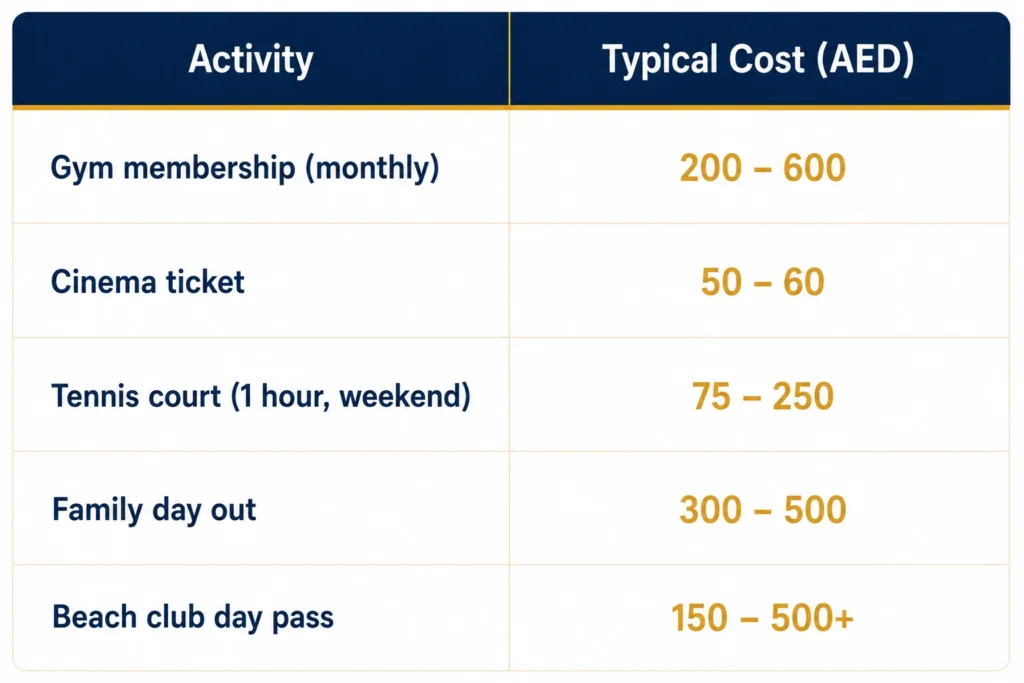
| Activity | Typical Cost (AED) |
| Gym membership (monthly) | 200 – 600 |
| Cinema ticket | 50 – 60 |
| Tennis court (1 hour, weekend) | 75 – 250 |
| Family day out | 300 – 500 |
| Beach club day pass | 150 – 500+ |
Expert insight: Dubai has an unusually wide range of free leisure options relative to its luxury reputation, public beaches, parks (Zabeel Park, Safa Park), and the Dubai Fountain show cost nothing, and many residents underuse them simply because Dubai’s marketing skews so heavily toward its paid, premium experiences.
Hidden Costs Nobody Talks About
Beyond rent and monthly bills, first-year residents typically face AED 8,000–20,000+ in one-time setup costs: a real estate agency fee (usually 5% of annual rent), a security deposit (5–10% of annual rent), a DEWA connection deposit, Ejari registration, and moving/furnishing costs, all of which are easy to underestimate if you’re only budgeting the advertised monthly rent.
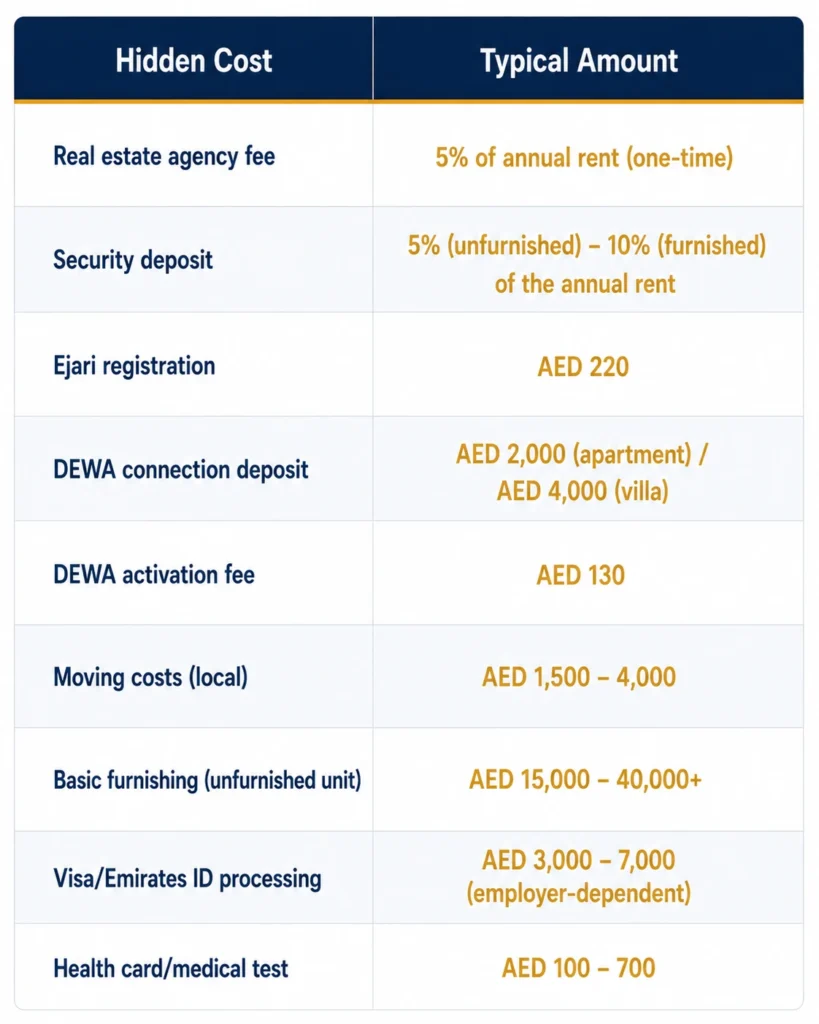
| Hidden Cost | Typical Amount |
| Real estate agency fee | 5% of annual rent (one-time) |
| Security deposit | 5% (unfurnished) – 10% (furnished) of the annual rent |
| Ejari registration | AED 220 |
| DEWA connection deposit | AED 2,000 (apartment) / AED 4,000 (villa) |
| DEWA activation fee | AED 130 |
| Moving costs (local) | AED 1,500 – 4,000 |
| Basic furnishing (unfurnished unit) | AED 15,000 – 40,000+ |
| Visa/Emirates ID processing | AED 3,000 – 7,000 (employer-dependent) |
| Health card/medical test | AED 100 – 700 |
Practical example: Renting an unfurnished 1-bedroom at AED 72,000/year (AED 6,000/month) means budgeting roughly: AED 3,600 agency fee + AED 3,600–7,200 security deposit + AED 220 Ejari + AED 2,000 DEWA deposit + AED 130 activation, over AED 9,500 in cash needed before you’ve paid a single month’s rent or bought a single piece of furniture.
Expert insight: The DEWA deposit is refundable when you close the account, but it’s rarely returned quickly or automatically. Budget for it as a real, if temporary, cash outlay rather than assuming it nets out immediately. Similarly, the security deposit is only returned at lease end, minus any deductions for damage, so it functions as locked-up capital for the duration of your tenancy, not a cost you’ll see again soon.
How Much Salary Do You Need to Live in Dubai?
AED 3,000/month is survival-only and not considered a good salary in Dubai. AED 7,000–8,000 is the realistic minimum for independent single living. From AED 12,000–18,000 supports a comfortable single lifestyle with savings, and families of four generally need AED 25,000–35,000+, depending on school choice.
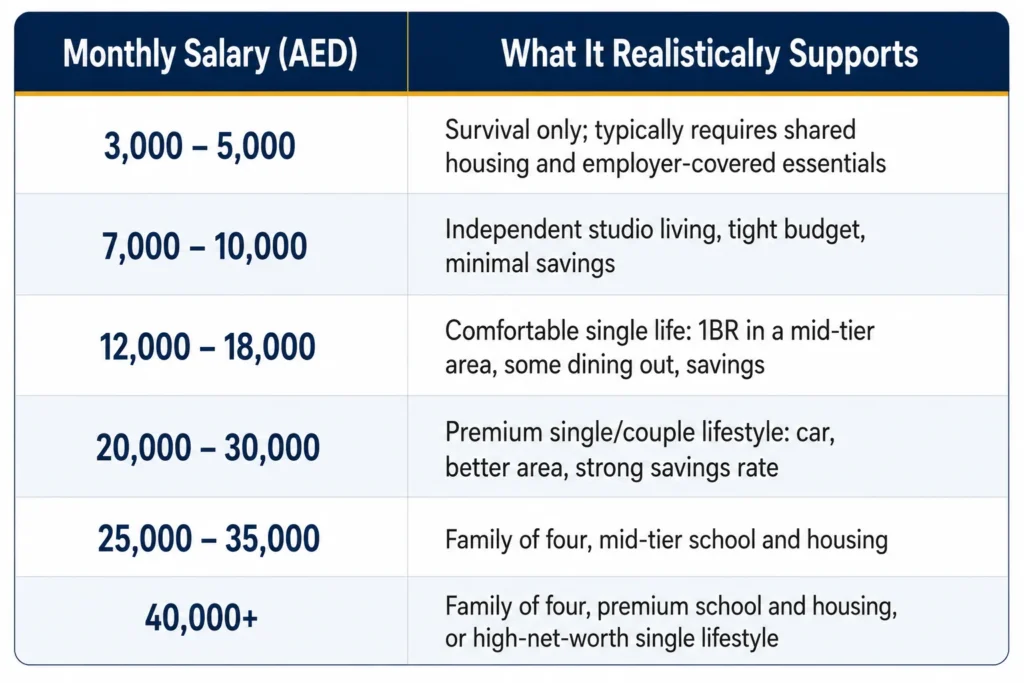
| Monthly Salary (AED) | What It Realistically Supports |
| 3,000 – 5,000 | Survival only; typically requires shared housing and employer-covered essentials |
| 7,000 – 10,000 | Independent studio living, tight budget, minimal savings |
| 12,000 – 18,000 | Comfortable single life: 1BR in a mid-tier area, some dining out, savings |
| 20,000 – 30,000 | Premium single/couple lifestyle: car, better area, strong savings rate |
| 25,000 – 35,000 | Family of four, mid-tier school and housing |
| 40,000+ | Family of four, premium school and housing, or high-net-worth single lifestyle |
Average salaries by profession (indicative, varies by employer and experience):
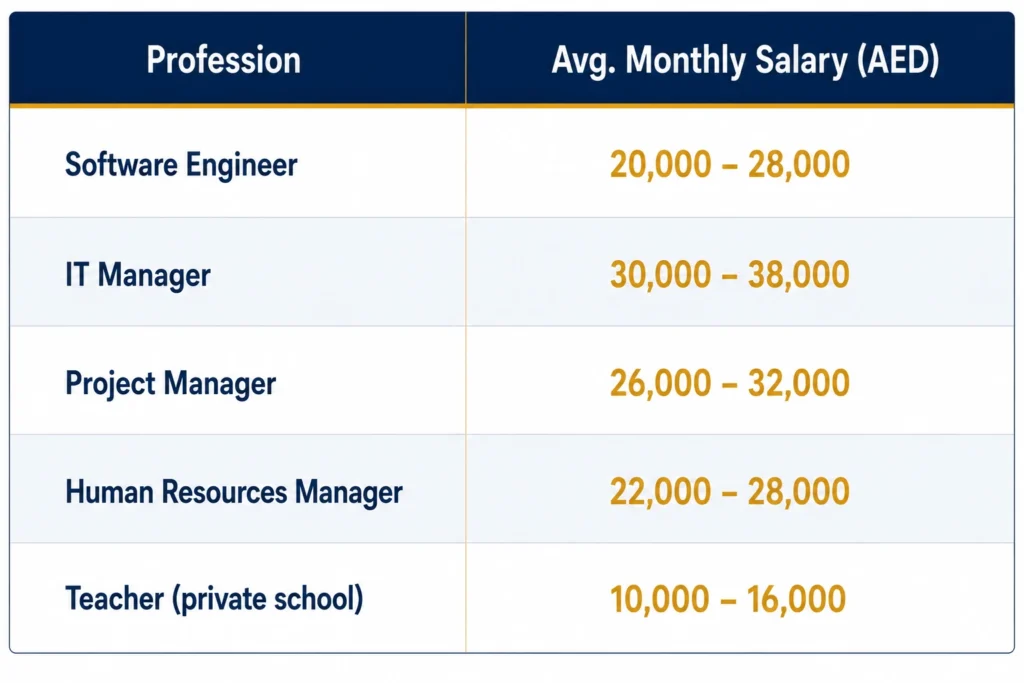
| Profession | Avg. Monthly Salary (AED) |
| Software Engineer | 20,000 – 28,000 |
| IT Manager | 30,000 – 38,000 |
| Project Manager | 26,000 – 32,000 |
| Human Resources Manager | 22,000 – 28,000 |
| Teacher (private school) | 10,000 – 16,000 |
Expert insight: Because the UAE has no personal income tax, the salary figures above are what you actually keep. An AED 20,000/month offer in Dubai isn’t directly comparable to an AED 20,000-equivalent salary in a country with 20–35% income tax, since the Dubai figure is fully take-home. Factor this into any salary negotiation or offer comparison against a home-country position.
Can You Save Money in Dubai?
Yes, the combination of zero income tax and a wide range of housing costs makes Dubai one of the more realistic places to build meaningful savings, provided your housing and school choices match your income tier rather than stretching beyond it.
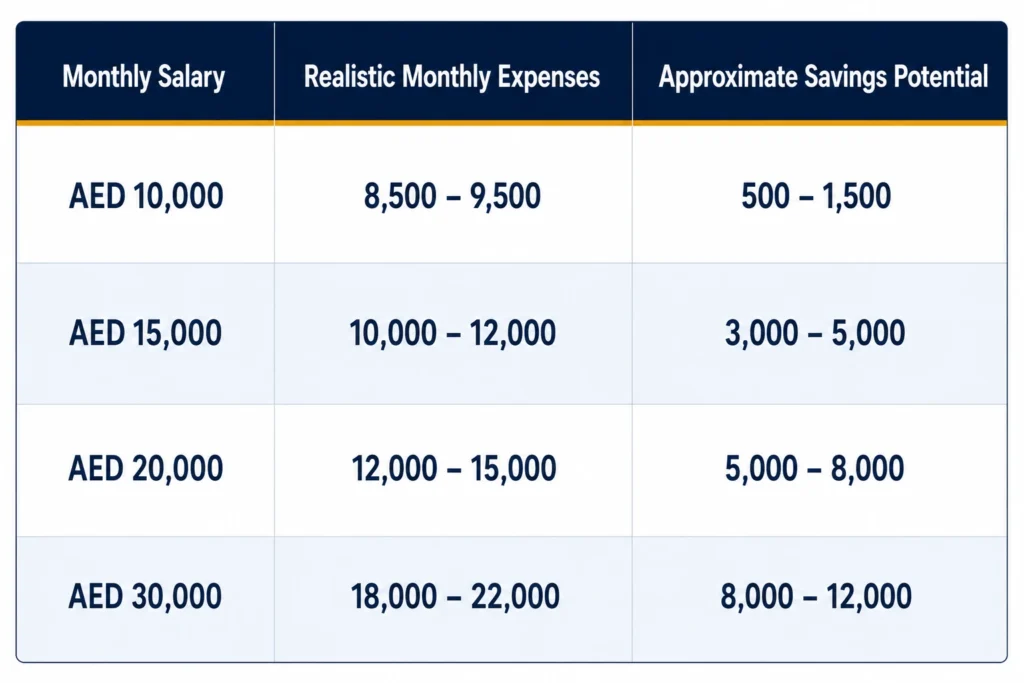
| Monthly Salary | Realistic Monthly Expenses | Approximate Savings Potential |
| AED 10,000 | 8,500 – 9,500 | 500 – 1,500 |
| AED 15,000 | 10,000 – 12,000 | 3,000 – 5,000 |
| AED 20,000 | 12,000 – 15,000 | 5,000 – 8,000 |
| AED 30,000 | 18,000 – 22,000 | 8,000 – 12,000 |
Practical example: A single professional earning AED 15,000/month, living in JVC (rent AED 5,500), spending AED 3,500 on food/utilities/transport combined, and AED 1,500 on entertainment and insurance, spends roughly AED 10,500, leaving AED 4,500/month, or AED 54,000/year, in savings. The same salary in Dubai Marina, with rent closer to AED 9,000, cuts that savings margin to under AED 1,000/month.
Expert insight: The single highest-leverage decision for anyone trying to save in Dubai is choosing a home 20–30 minutes further from the city center in exchange for a rent that’s 30–40% lower. Because rent is the largest line item by far, this one decision typically has more impact on your savings rate than any combination of smaller lifestyle cuts.
Dubai vs Other Cities: Cost of Living Comparison
Dubai is more affordable than Hong Kong, Singapore, London, New York, and Zurich for overall monthly expenses excluding rent, while being significantly more expensive than Islamabad or most South Asian cities. Rent in Dubai’s city center is typically lower than in London or New York but higher than in Hong Kong or Singapore for comparable space.
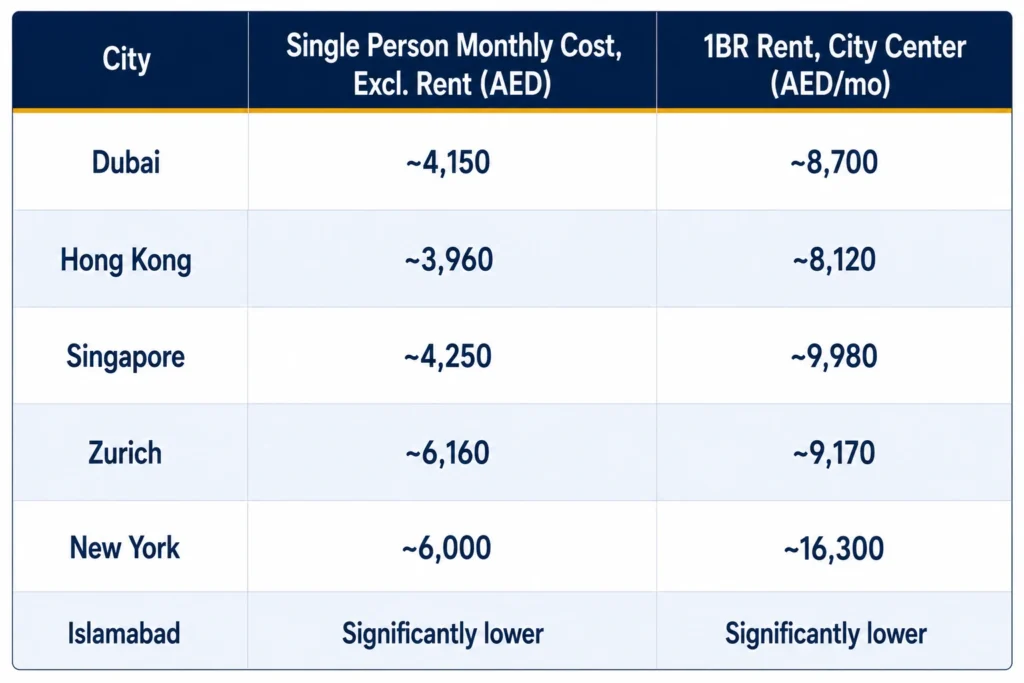
| City | Single Person Monthly Cost, Excl. Rent (AED) | 1BR Rent, City Center (AED/mo) |
| Dubai | ~4,150 | ~8,700 |
| Hong Kong | ~3,960 | ~8,120 |
| Singapore | ~4,250 | ~9,980 |
| Zurich | ~6,160 | ~9,170 |
| New York | ~6,000 | ~16,300 |
| Islamabad | Significantly lower | Significantly lower |
Figures reflect recent international cost-of-living index data (Numbeo-based comparisons, Source: Knight Frank ); Dubai sits roughly mid-pack among major global business hubs for day-to-day costs, while its rent remains notably lower than New York’s for equivalent city-center space.
space for money: At the same USD 1 million budget, a buyer typically secures roughly 78 sq. meters of living space in Dubai, compared to around 32 sq. meters in Singapore and 22 sq. meters in Hong Kong, meaning Dubai buyers can generally secure 2–3x more space for the same capital than in comparable global cities, a major reason international investors increasingly compare Dubai against these markets rather than against cities with cheaper headline costs.
Expert insight for Pakistan-based readers specifically: the gap between Islamabad and Dubai is real and substantial, Dubai’s overall cost of living runs well over 100% higher than Islamabad’s, and rent alone is commonly cited as roughly 7–8x higher. That gap is exactly why salary negotiation before relocating matters more in this direction than almost any other: a salary that feels generous in Pakistani Rupees can still be tight in Dubai once rent, schooling, and insurance are converted at current exchange rates.
Real Budget Examples by Profile
Below are four realistic, fully itemized monthly budgets: student, single professional, couple, and family of four, built from the ranges established throughout this guide so that you can double-check your own numbers against a complete example rather than a single average figure.
Student, sharing accommodation, AED 4,800/month total Rent (shared room): 2,500 · Groceries: 900 · Transport (Nol card): 250 · Mobile/internet share: 200 · Entertainment: 500 · Miscellaneous/buffer: 450 · (Excludes tuition, which is billed separately)
Single professional, JVC 1-bedroom , AED 9,650/month total Rent: 5,500 · DEWA: 550 · Groceries: 900 · Dining out: 700 · Transport (metro): 350 · Insurance: 300 · Gym/entertainment: 500 · Miscellaneous/buffer: 850
Couple, Business Bay 1-bedroom , AED 15,900/month total Rent: 8,500 · DEWA: 700 · Groceries: 1,800 · Dining out: 1,500 · Transport (metro + occasional taxi): 700 · Insurance: 500 · Entertainment: 900 · Miscellaneous/buffer: 1,300
Family of four, Dubai Hills Estate 3-bedroom, AED 32,400/month total Rent: 14,000 · DEWA: 1,600 · Groceries: 3,500 · Dining out: 2,000 · Transport (one car, all costs): 2,500 · Insurance (family): 1,200 · School fees (2 children, mid-tier, monthly equivalent): 5,800 · Entertainment: 1,500 · Miscellaneous/buffer: 300
Key takeaway: Notice that the “miscellaneous/buffer” line shrinks as a proportion of the total in the family example. This is realistic, and it’s exactly why families have less room for budgeting error than singles do. A family budget built without an explicit buffer line will run into trouble the first month a school trip fee or medical bill shows up unexpectedly.
What Dubai Residents Actually Say (Community Insights)
Across Reddit discussions from people actually living in Dubai, community consensus for a single male living a “decent, not luxurious” lifestyle clusters tightly between AED 10,000 and AED 15,000/month, with several experienced residents specifically flagging that “decent” is subjective and depends heavily on which neighborhood and dining habits you choose.
Real, on-the-ground estimates from Dubai residents discussing this exact question consistently break down like this: a studio at AED 5,000–6,000/month, utilities and phone plans around AED 1,000, a car installment near AED 2,000 if you choose to own one, and AED 2,000–3,000 for groceries and going out, arriving at a similar AED 10,000–14,000 range independently of the official cost-of-living surveys cited elsewhere in this guide, which is a useful cross-check.
What people say they regret:
underestimating agency fees and deposits before moving, choosing a “cheap” apartment far from work and then spending the savings on taxis anyway, and not budgeting separately for the “invisible” annual costs, insurance renewal, Ejari renewal, and car registration, that don’t show up in a monthly mental budget.
What surprises newcomers most:
Several residents specifically note that decent living in Dubai is achievable well below what outsiders assume, with one experienced commenter pointing out that AED 3,000/month is enough to survive (though not comfortably) if rent and transport are minimized, directly contradicting the “Dubai is only for rich people” perception that drives a lot of hesitation about moving.
Reality vs. expectations:
The most consistent theme across community discussions is that Dubai punishes lifestyle inflation more than it punishes a tight starting budget. Residents who arrive with a clear number and stick to it rate the city as very livable, while residents who let their spending drift upward with each pay rise rate it as unexpectedly tight even on above-average salaries.
The community perspectives above reflect informal, self-reported experiences from residents and are included to provide practical, lived context; they should be read alongside, not instead of, the official and verified pricing data used elsewhere in this guide.
Common Mistakes to Avoid
The five most common cost-of-living mistakes are: choosing an apartment based on rent alone without factoring in DEWA and commute costs, underestimating the upfront cash needed for deposits and agency fees, ignoring school fee tiers until after choosing a home, forgetting that rent is usually paid in large upfront cheques rather than monthly, and letting summer utility bills catch you by surprise.
- Moving without a full first-month budget. Rent alone isn’t the number to compare against your salary; add DEWA, agency fee amortized over the lease, and commute costs before deciding an apartment is “affordable.”
- Ignoring the deposit and agency fee until move-in week. These typically total 10–15% of the annual rent upfront in cash, and discovering this after you’ve already committed to a unit creates unnecessary financial stress.
- Choosing the wrong area for your actual commute. A cheaper rent 40 minutes from work, with no direct metro line, often costs more in time and ride-hailing fares than a slightly pricier apartment on the metro corridor.
- Ignoring school fees until after signing a lease. Families frequently pick a home first and discover afterward that the nearest good school is in a premium tier they hadn’t budgeted for; school choice should come before or alongside home choice.
- Ignoring summer utility spikes. Budgeting your DEWA bill based on a mild winter month, only to be surprised by a summer bill 2–3x higher, is one of the most common first-year budgeting failures.
Money-Saving Tips
The highest-impact ways to reduce living costs in Dubai are choosing an area 20–30 minutes farther from the center, using the metro instead of owning a car if your commute allows it, shopping at hypermarkets rather than premium supermarkets, and negotiating a multi-cheque rent payment rather than assuming you must pay the full year upfront.
- Housing: Every step away from Downtown/Marina toward JVC, Silicon Oasis, or Dubai South typically saves 25–40% on rent for a comparable unit.
- Transport: Metro/bus costs roughly AED 300/month versus AED 1,500–3,500+ for car ownership, a difference that alone can fund a meaningfully better apartment.
- Groceries: Shopping at Carrefour, Lulu Hypermarket, or Spinneys rather than premium grocers can cut a monthly grocery bill by 20–30%.
- Entertainment: Dubai’s public beaches, parks, and the Dubai Fountain show are free, a genuinely underused way to enjoy the city without the premium price tag attached to paid attractions.
- Rent cheques: Negotiating a 4-cheque or even a monthly payment plan instead of a 1-cheque annual payment preserves cash flow, even if landlords sometimes charge a small premium for the flexibility.
- Utilities: Setting AC to 24°C and addressing leaks immediately are the two highest-leverage, lowest-effort DEWA savings available to any household.
Pros and Cons of Dubai’s Cost of Living
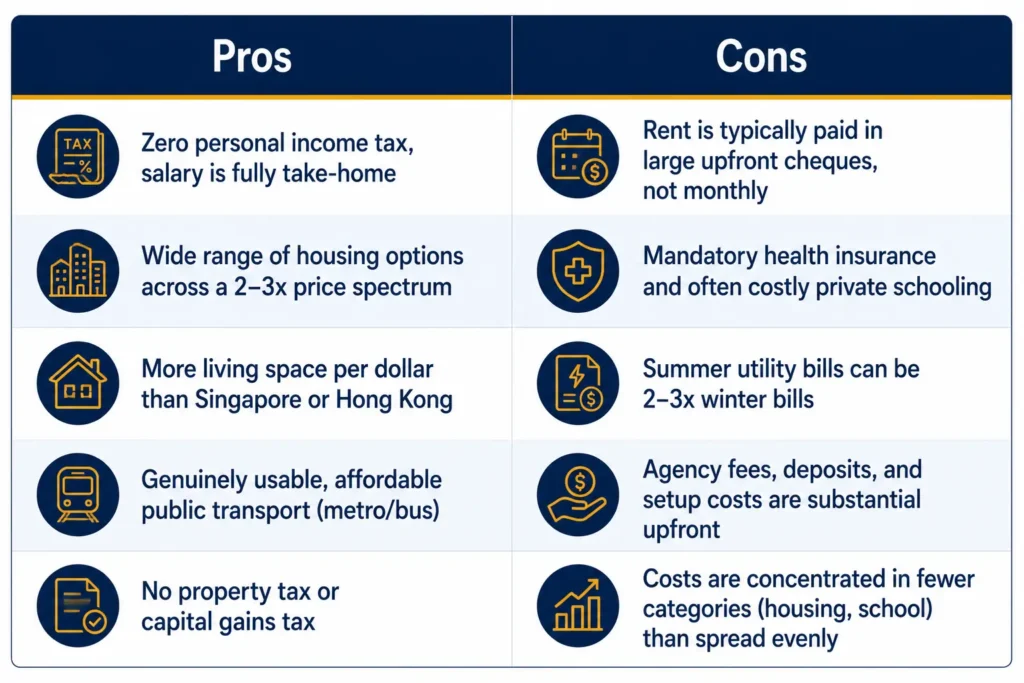
| Pros | Cons |
| Zero personal income tax, salary is fully take-home | Rent is typically paid in large upfront cheques, not monthly |
| Wide range of housing options across a 2–3x price spectrum | Mandatory health insurance and often costly private schooling |
| More living space per dollar than Singapore or Hong Kong | Summer utility bills can be 2–3x winter bills |
| Genuinely usable, affordable public transport (metro/bus) | Agency fees, deposits, and setup costs are substantial upfront |
| No property tax or capital gains tax | Costs are concentrated in fewer categories (housing, school) than spread evenly |
Cost of Living and the Buy-vs-Rent Decision
At current rent levels in many affordable-to-mid-tier areas, a developer payment plan on an off-plan apartment can bring the monthly outlay close to comparable rent, while building equity instead of paying a landlord. Buyers investing AED 2 million or more may also qualify for the UAE’s 10-year Golden Visa, which offers a residency benefit that renting doesn’t provide.
This guide has focused on the cost of living in Dubai for renters, since that’s the reality for most newcomers in their first year or two. But for residents planning to stay several years, it’s worth running the rent-vs-buy comparison explicitly, because Dubai’s off-plan payment plan structure changes the math compared to many home markets:
- Off-plan payment plans commonly spread the purchase price over the construction period plus a post-handover period, with some developers offering plans as low as 1% of the property value per month, which, on a mid-tier 1-bedroom, can land close to the rent you’d otherwise pay for a comparable unit.
- The Golden Visa link: as of 2026, a property investment of AED 2 million or more (in a single property or a combined portfolio) qualifies for the UAE’s 10-year Golden Visa. Since February 2026, off-plan and mortgaged properties both qualify, and the previous requirement to have already paid 50% of the property value has been removed, meaning a well-structured off-plan purchase can qualify for residency well before it’s fully paid off. This is a materially different calculation than most rental markets, where rent buys you nothing beyond the lease term.
- What renting still wins on: flexibility to relocate neighborhoods or leave Dubai entirely without a sales process, no exposure to market price movements, and no responsibility for service charges or maintenance.
Decision guide:
If you’re in Dubai for a defined 1–2 year assignment, renting is almost always the more practical choice. If you’re planning to stay 3+ years, have identified a specific community you’d choose to live in long-term anyway, and especially if you’re at or near the AED 2 million investment threshold, it’s worth comparing an off-plan payment plan directly against your current rent; the numbers are often closer than people expect. Our first-time buyer guide and overview of off-plan projects are good starting points if you want to run that comparison in your own situation.
This section is informational and reflects publicly available 2026 guidance on Golden Visa property eligibility; requirements may change, and anyone considering a purchase specifically for residency should confirm the current rules with a licensed advisor or directly with the Dubai Land Department before committing.
Frequently Asked Questions
Q1: Is Dubai expensive to live in?
Ans: Dubai is moderately expensive by global standards, more affordable than London, New York, or Singapore for day-to-day expenses, but significantly more expensive than most South Asian cities. Rent is the dominant cost, and it varies by 2–3x depending on the neighborhood, so “expensive” or “affordable” depends heavily on where you choose to live rather than on the city as a whole.
Q2: How much does it cost to live in Dubai per month?
Ans: A single person’s realistic all-in monthly budget, including rent, is between AED 6,000 and 13,000. A family of four typically needs AED 20,000–45,000, primarily due to housing size and school fees. See the Quick Monthly Cost Summary above for a full breakdown by lifestyle.
Q4: What salary do I need to live comfortably in Dubai?
Ans: A single professional needs roughly AED 12,000–18,000/month for a comfortable, independent lifestyle with savings. Families of four generally need AED 25,000–35,000+, depending heavily on school tier. Since Dubai has no income tax, these figures represent full take-home pay.
Q5: Can I live in Dubai on AED 5,000 a month?
Ans: It’s very difficult as an independent single person, since a studio alone often costs AED 3,500–4,000+. AED 5,000/month is realistic only if you’re sharing accommodation or your employer covers housing, leaving little room for savings or discretionary spending.
Q6: Is AED 3,000 a good salary in Dubai?
Ans: No, AED 3,000/month is considered survival money in Dubai, not a good salary. It typically requires sharing a room, minimizing food and transport spending, and offers essentially no capacity to save, unless housing and other major costs are covered separately.
Q7: Is AED 10,000 a good salary in Dubai?
Ans: AED 10,000/month supports independent studio living in an affordable area with a tight budget and modest savings. It’s workable for a single person prioritizing cost over lifestyle, but it leaves little cushion for unexpected expenses or a premium-area choice.
Q8: How much does a family of four need to live in Dubai?
Ans: A family of four typically needs AED 25,000–35,000/month for a mid-tier lifestyle (2–3 bedroom apartment, mid-tier private school for two children, one car), rising to AED 45,000+ for premium schools and waterfront or villa communities.
Q9: Is Dubai more expensive than Abu Dhabi?
Ans: Dubai and Abu Dhabi are broadly comparable, with Dubai often slightly higher for premium waterfront and downtown rents specifically, while general day-to-day costs (groceries, transport, dining) are similar across both emirates.
Q10: Is Dubai cheaper than the US or the UK?
Ans: For overall monthly living costs, excluding rent, Dubai is roughly comparable to, or slightly cheaper than, major US and UK cities. Specifically for rent, Dubai’s city-center 1-bedroom rates are notably lower than those in New York. They are broadly comparable to or below many UK city-center rates, while offering significantly more space for the money in both cases.
Q11: What is the cheapest area to live in Dubai?
Ans: International City consistently ranks as the lowest-cost area for studio and shared accommodation, followed closely by Dubai Silicon Oasis, Discovery Gardens, and Al Qusais, all of which retain reasonable public transport access despite their lower rents. See Best Affordable Areas above for a full comparison.
Q12: How much is rent in Dubai?
Ans: Rent ranges from roughly AED 2,800/month for a studio in an affordable area to AED 14,000+/month for a 1-bedroom in a premium community like Downtown Dubai or Palm Jumeirah. See the Accommodation Costs table above for the full breakdown by unit size and area tier.
Q13: How much are DEWA bills in Dubai?
Ans: A typical 1-bedroom apartment’s combined electricity, water, and municipality fee bill runs AED 400–600/month in winter and AED 700–1,100/month in summer, when air conditioning use rises sharply. Larger villas can see summer bills of AED 2,500–5,000+.
Q14: Do I need a car in Dubai, or is public transport enough?
Ans: Public transport is genuinely sufficient if you live and work along the metro corridor (Marina, JLT, Business Bay, Downtown, Deira). If your home or workplace is in a villa community or an area without direct metro access, Dubai Hills Estate, Arabian Ranches, or most of Dubai South, a car or a consistent ride-hailing budget becomes nearly essential.
Q15: How much do groceries cost in Dubai per month?
Ans: A single person cooking most meals at home spends roughly AED 800–1,200/month; a family of four spends AED 2,500–4,000/month. Shopping at hypermarkets like Carrefour or Lulu, rather than at premium grocers, can meaningfully lower this.
Q16: Is health insurance mandatory in Dubai?
Ans: Yes. Dubai Health Authority regulations require every resident to have health insurance, typically arranged through an employer for salaried workers. Freelancers, remote workers, and those without employer coverage must arrange private insurance themselves, generally costing AED 5,000–15,000+/year for comprehensive coverage.
Q17: How much are school fees in Dubai?
Ans: Private school fees, the default for most expat families, range from roughly AED 12,000/year at the budget end to over AED 100,000/year at premium international schools. KHDA caps annual fee increases, providing some predictability for multi-year budgeting.
Q18: What are the hidden costs of moving to Dubai?
Ans: Beyond monthly rent, expect a one-time agency fee (5% of annual rent), a security deposit (5–10% of annual rent), Ejari registration (AED 220), a DEWA connection deposit (AED 2,000–4,000), and furnishing costs if the unit is unfurnished, commonly AED 8,000–20,000+ in total setup costs.
Q19: Can I save money living in Dubai?
Ans: Yes. With no personal income tax and a wide range of housing costs, disciplined budgeting, particularly choosing housing 20–30 minutes from the center rather than premium waterfront areas, often allows AED 3,000–12,000/month in savings, depending on income level.
Q20: Is it cheaper to rent or buy in Dubai?
Ans: It depends on your time horizon. Renting wins for stays of 2–3 years or less due to its flexibility and lack of market exposure. For longer stays, an off-plan payment plan can bring monthly outlays close to rent while building equity. See Cost of Living and the Buy-vs-Rent Decision above for a fuller comparison.
Q21: How much property investment do I need for a UAE Golden Visa?
Ans: AED 2 million in real estate (a single property or a combined portfolio) qualifies for the 10-year Golden Visa as of 2026. Off-plan and mortgaged properties both qualify, and since February 2026, buyers no longer need to have already paid 50% of the property value upfront.
Q22: Is Dubai affordable for students?
Ans: Yes, if accommodation is shared rather than a private apartment. Students sharing a room typically budget AED 4,500–7,500/month, excluding tuition, which is billed separately by the university.
Q23: What is the average salary in Dubai?
Ans: Average salaries vary widely by profession and experience, from roughly AED 10,000–16,000/month for entry-level and teaching roles to AED 25,000–38,000+ for experienced professionals in IT, engineering, and management. See the salary table above for profession-specific benchmarks.
Q24: How much does it cost to live in Dubai compared to Islamabad?
Ans: Substantially more. Dubai’s overall cost of living runs well over 100% higher than Islamabad’s, with rent commonly cited as 7–8x higher. Anyone relocating from Pakistan should explicitly factor this gap into salary negotiations rather than assuming a Dubai offer that looks large in AED will stretch as far as the same amount would at home.
Q25: How much cash should I have ready before moving to Dubai?
Ans: Budget for at least one to two months of living expenses plus the full hidden costs total (agency fee, deposit, Ejari, DEWA deposit, and basic furnishing if needed), realistically AED 15,000–30,000 in accessible funds before your first payday, even if your employer covers your visa costs.
Q26: Does Dubai have income tax?
Ans: No. The UAE does not levy personal income tax, meaning your full salary is your take-home pay. This is a major reason gross salary figures in Dubai aren’t directly comparable to gross salaries in countries where 20–35% is deducted before it reaches your account.
Final Verdict: Is Dubai’s Cost of Living Right for You?
Dubai’s cost of living rewards deliberate choices and punishes drift. A single professional earning AED 12,000+ or a family earning AED 25,000+ who chooses housing and schooling carefully can live comfortably and save meaningfully; the same income stretched across a Downtown or Marina lease and a premium school tier will feel tight regardless of how large the salary looks on paper.
For students: Dubai is genuinely affordable if you share accommodation and stick close to a metro line, budget AED 5,000–7,500/month excluding tuition, and prioritize universities that offer subsidized housing.
For single professionals: AED 12,000–15,000/month is the realistic threshold for comfortable, independent living with savings. Below that, expect to share accommodation or accept a tighter lifestyle in exchange for building savings faster.
For families: School choice matters more than home choice; decide on a school tier first, then choose housing within a comfortable commuting distance of it, rather than the reverse. Budget AED 25,000–35,000/month for a mid-tier lifestyle.
For investors and prospective buyers: if you’re comparing the cost of renting versus buying, run the numbers for a specific off-plan payment plan rather than relying on a general assumption. In several affordable-to-mid-tier communities, the monthly outlay lands closer to rent than most newcomers expect, with the added possibility of Golden Visa eligibility at the AED 2 million mark. Our investment guide and current off-plan project listings are the logical next step if that comparison applies to you.
The one number worth remembering: whatever your profile, the neighborhood you choose swings your total cost of living by 40–100% more than any other single decision. Get that one right for your budget, and the rest of this guide’s ranges will work in your favor rather than against you.