
Overview
A furnished apartment in Dubai comes with the bed, sofa, a fully equipped kitchen, and built-in wardrobes already in place. You can move in with a suitcase and start living the same day. Monthly rents for furnished units start around AED 2,439 for a small studio and can run past AED 17,000 once you factor in the larger, more central buildings. Leases run from one month up to a full year.
Two very different renters end up shopping that same range. One is on a two-year work contract and doesn’t want to spend their first paycheck furnishing a place they might leave early. The other is in Dubai for six weeks and just wants a real kitchen instead of a hotel room. Both end up looking at the same listings. This guide follows the decisions that separate them, starting with the one that matters most: how long you’re really staying. Get that answer right, and it tells you whether monthly rent or annual rent works out cheaper, and which areas are worth it for that timeframe.
Why Rent a Furnished Apartment in Dubai?
Two things make the higher rent worth it. You skip buying furniture you’d probably just sell or bin later, and you skip the weeks it normally takes to get a new home running. In a city where most tenants are on visas tied to a job or a fixed project, that trade-off tends to pay for itself.
Convenience
You skip the furniture shopping and the delivery windows. DEWA and internet are often already running, or ready to switch on within a day. If you’re starting work the morning after you land, you save real time.
Move-in Ready Homes
The kitchen already has a stove, a fridge, and basic cookware. The bed and wardrobes are already in the bedroom. Move-in ready means exactly that: you can cook a meal and sleep in a proper bed the same day, no delivery truck required.
Flexible Rental Options
Since you don’t own the furniture, walking away from a lease costs a lot less. Maybe you’re not sure whether Business Bay suits your commute, or whether you’d rather be closer to the beach. That flexibility matters, and it’s better to find out before signing a 12-month contract than after.
Types of Furnished Apartments in Dubai
Furnished apartments in Dubai come in five main setups: studio, 1-bedroom, 2-bedroom, luxury, and fully furnished. The right one for you comes down to your budget and how much space you actually use.
Studio Furnished Apartments
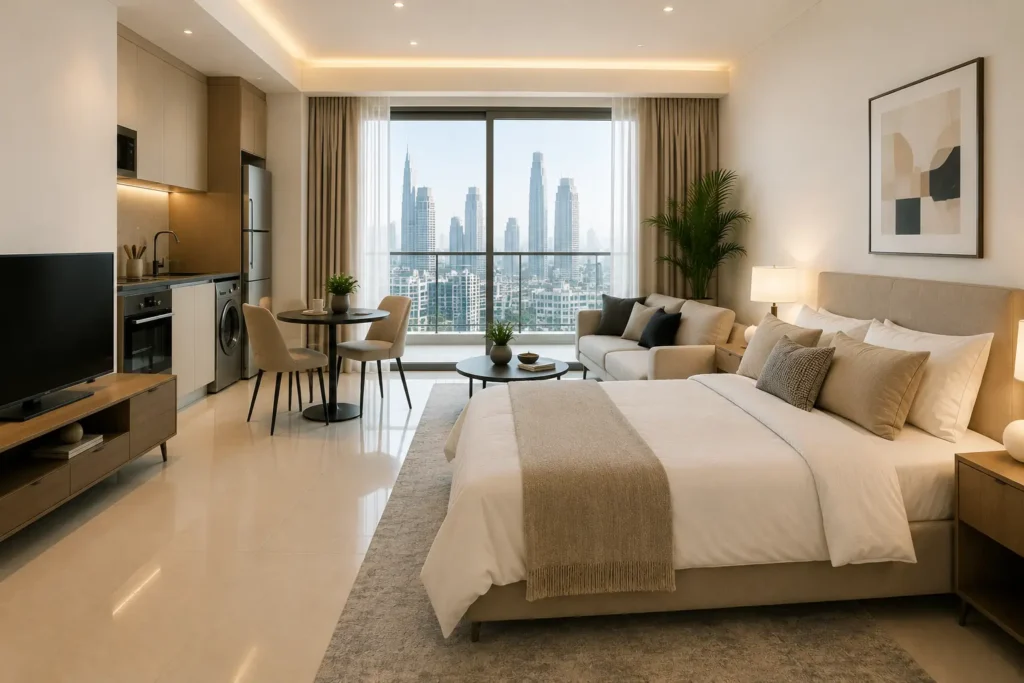
A studio furnished apartment in Dubai runs about 350 to 600 square feet and rents for roughly AED 2,439 to AED 17,300 a month, depending on the area. Palm Jumeirah and Downtown Dubai sit at the higher end, while JVC and Bur Dubai come in cheaper. It’s one open room for living and sleeping plus a separate bathroom, which works fine if you’re single, working long hours, and don’t need space you won’t use.
1 Bedroom Furnished Apartments
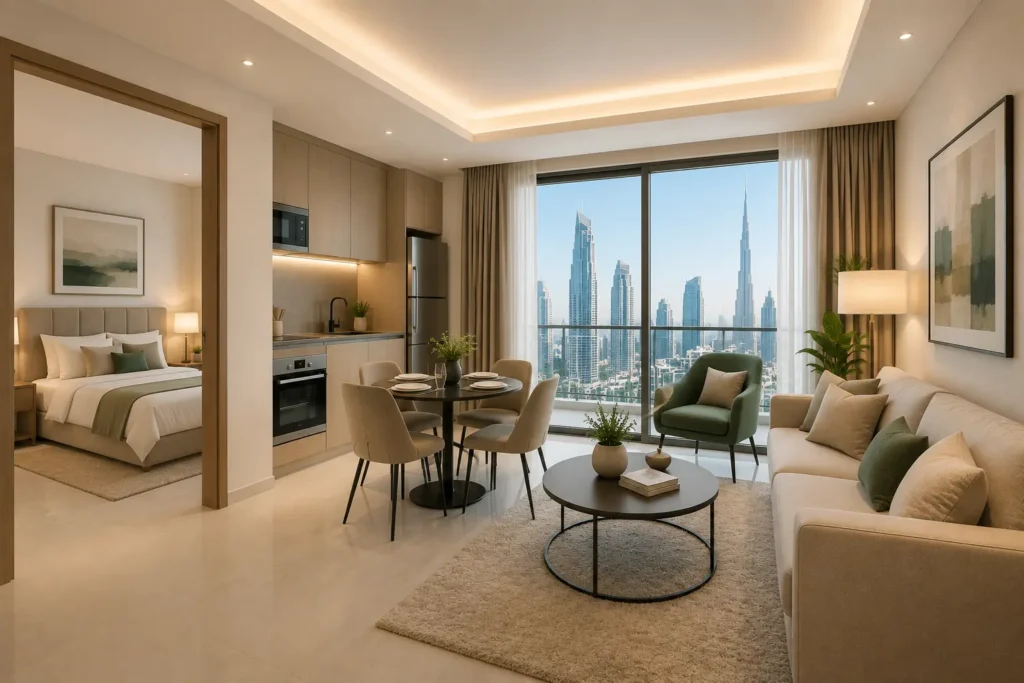
A 1 bedroom furnished apartment usually runs AED 2,650 to AED 21,299 a month and gives you a separate bedroom, a proper living area, and a balcony. Most couples and young professionals settle on this size, since it’s enough room to truly live in without paying for space you’re not using.
2 Bedroom Furnished Apartments
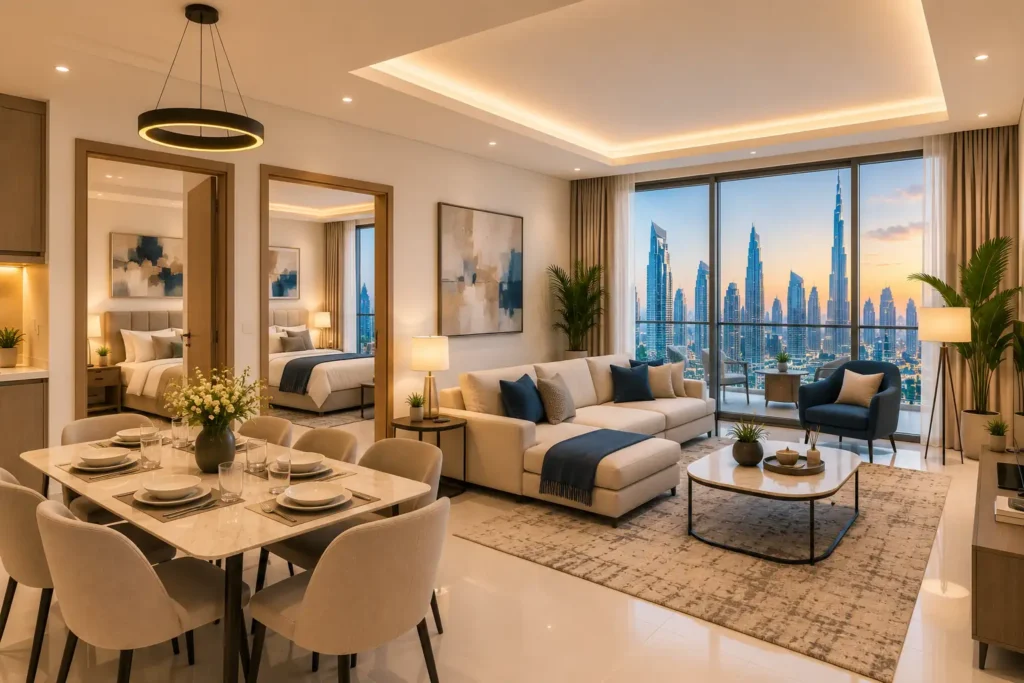
A 2 bedroom furnished apartment makes sense once you’ve got a roommate, a partner who works from home and needs a second room as an office, or a small family. Rent starts around AED 5,500 as a rule, and can climb past AED 56,000 in the biggest, best-located units, particularly on the Palm.
Luxury Furnished Apartments
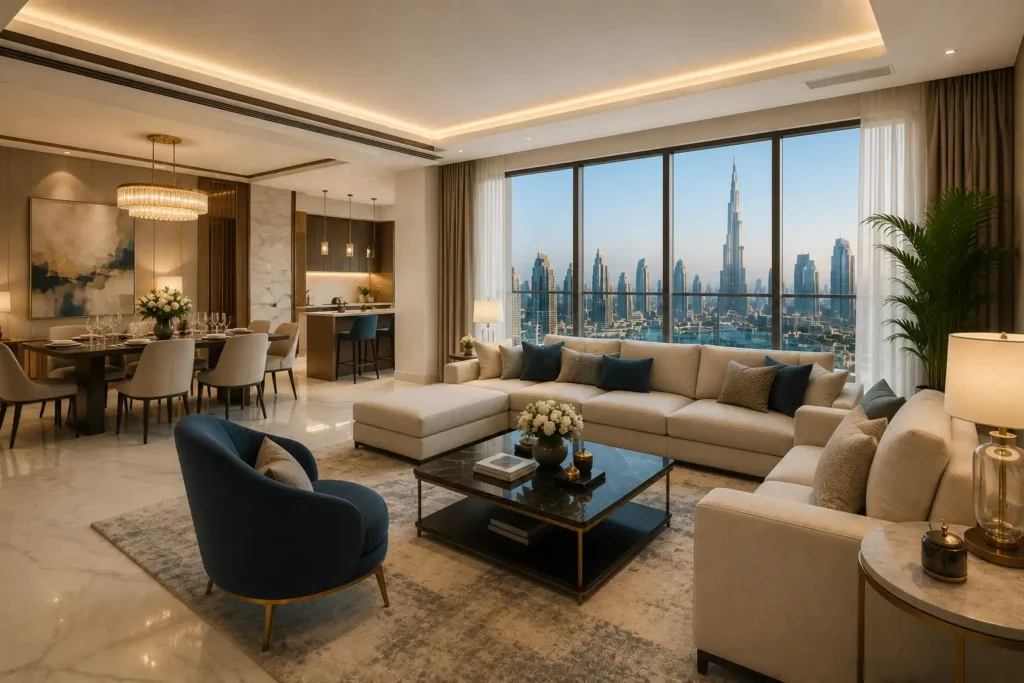
Luxury furnished apartments in Dubai often mean a building with a swimming pool, a gym, and round-the-clock security. The unit itself comes finished with proper materials instead of the cheapest fittings available. Most of these sit in Palm Jumeirah, Dubai Marina, and Downtown Dubai, and rent starts climbing well past AED 15,000 a month for anything with a real view.
Fully Furnished Apartments
Fully furnished means everything, right down to the cutlery, bed linen, and curtains, is already in the apartment. A lot of listings say “furnished” but only include the big items like a bed and a sofa. Don’t want to buy plates and towels on the day you move in? Confirm directly with the landlord or agent whether the unit is genuinely fully furnished or only partially kitted out.
Furnished vs Unfurnished Apartments in Dubai
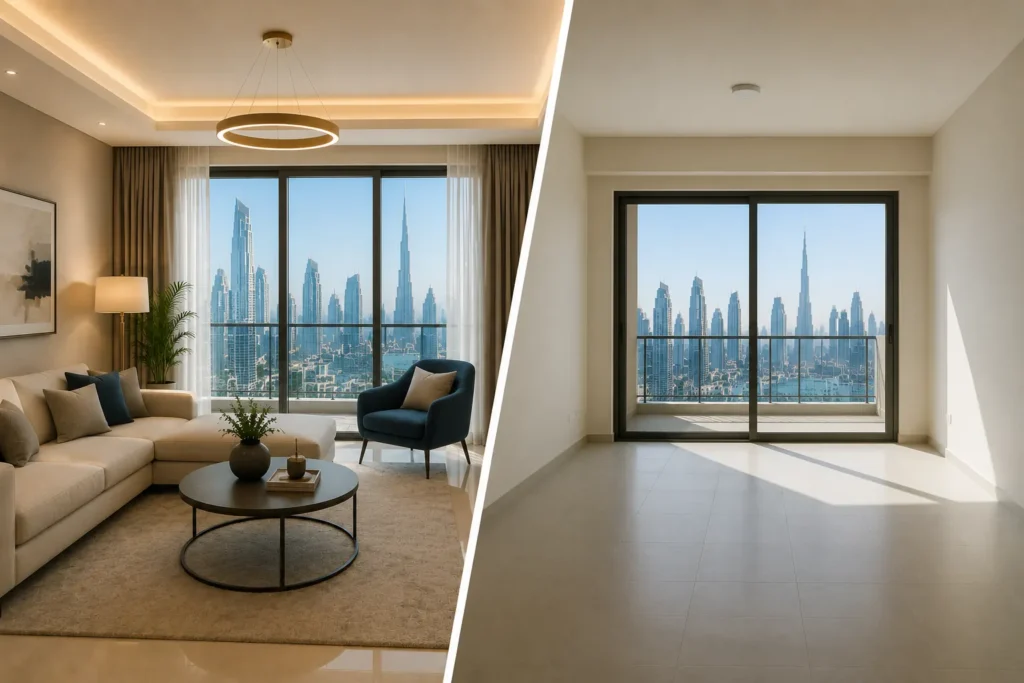
Renting furnished costs 15 to 25% more a year than renting the same apartment unfurnished, as a general rule. If you rented unfurnished instead and furnished it yourself, a studio costs about AED 8,000 to 25,000 to kit out. A 1 bedroom furnished apartment’s worth of furniture runs AED 15,000 to 35,000. Which option saves you money comes down to one thing: how long you’re staying.
Stay a year or less, and the extra rent on the furnished unit tends to land close to what you’d have spent furnishing the place yourself. You also skip the shopping trips, the delivery waits, and reselling everything before you fly out. Stay two years or longer, and that yearly premium adds up past what the furniture would have cost outright, so an unfurnished apartment starts winning on price.
Availability tells a different story though. Unfurnished apartments still make up most of the listings across Dubai. Landlords default to unfurnished because it costs less to maintain, and it suits long-term tenants who’d rather set the place up their own way. Finding a furnished apartment in Dubai in the exact building or area you want can sometimes mean fewer choices, not more, as a result.
Best Areas to Rent Furnished Apartments in Dubai
Palm Jumeirah sits at the top of the price range across every unit size. Downtown, Bur Dubai, and Business Bay all take turns as runner-up depending on room size. Bur Dubai and JVC offer the lowest starting prices, though both can swing surprisingly high in the right building, more on that below. Here’s what each one offers.
Downtown Dubai

A furnished 1 bedroom apartment in Downtown Dubai runs AED 5,999 to 15,500 a month, well above what the same size unit costs in JVC. You’re paying for proximity to Burj Khalifa and Dubai Mall more than for extra square footage.
It’s also one of the closest central areas to the airport, about 16 minutes by car. DIFC sits right next to it, so anyone working there or in Business Bay cuts their commute down to almost nothing. Buildings here run dense though, so units tend to run smaller for the price than what you’d get in Business Bay or Marina.
Dubai Marina
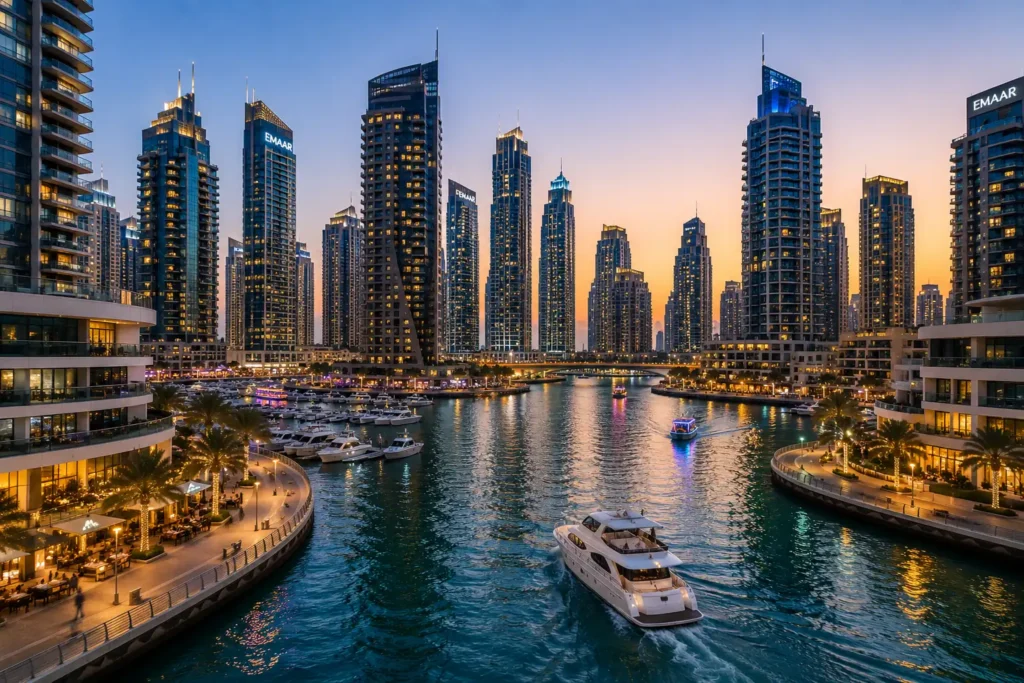
A furnished 1 bedroom apartment in Dubai Marina runs about AED 4,950 to 14,000 a month depending on the building and finish. The appeal here is straightforward: Marina Walk, JBR Beach, and a stretch of restaurants right outside your building. The bigger units are the real surprise, since they don’t carry a water-view premium the way you’d expect. Marina’s 2 bedroom ceiling comes in lower than anywhere else on this list, so anyone chasing the view often finds better value here than in Downtown or Business Bay.
It also sits among the furthest of the popular areas from the airport, around 29 minutes by car, same as Palm Jumeirah. Metro access to the rest of the city is slower than it looks on a map, closer to 50 minutes once you account for transfers. If your daily routine depends on the airport or Downtown, factor that drive in before signing.
Business Bay
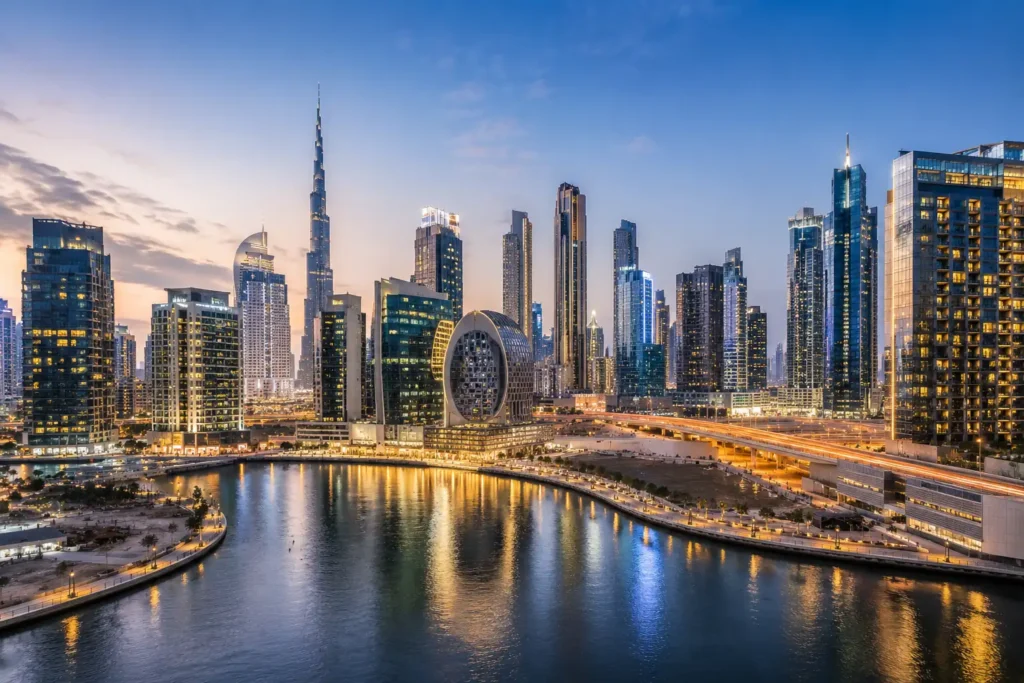
A furnished studio in Business Bay costs around AED 4,000 to 7,000 a month, the tightest range on this whole list. This is one of the few areas that gives you a real business district. You also get a five minute drive to Downtown’s restaurants and the Dubai Canal, without paying Downtown rent.
The airport is close too, about 16 minutes, tied with Downtown and behind only Bur Dubai for the shortest run on this list. Easy access like that is a big reason this area has become one of the busiest addresses for furnished listings in the city. Just don’t assume that budget-friendly studio pricing carries over to bigger units. Business Bay’s 2 bedroom ceiling climbs to AED 45,000, second only to Palm Jumeirah. Price out a larger unit here before you fall for the canal view.
Palm Jumeirah
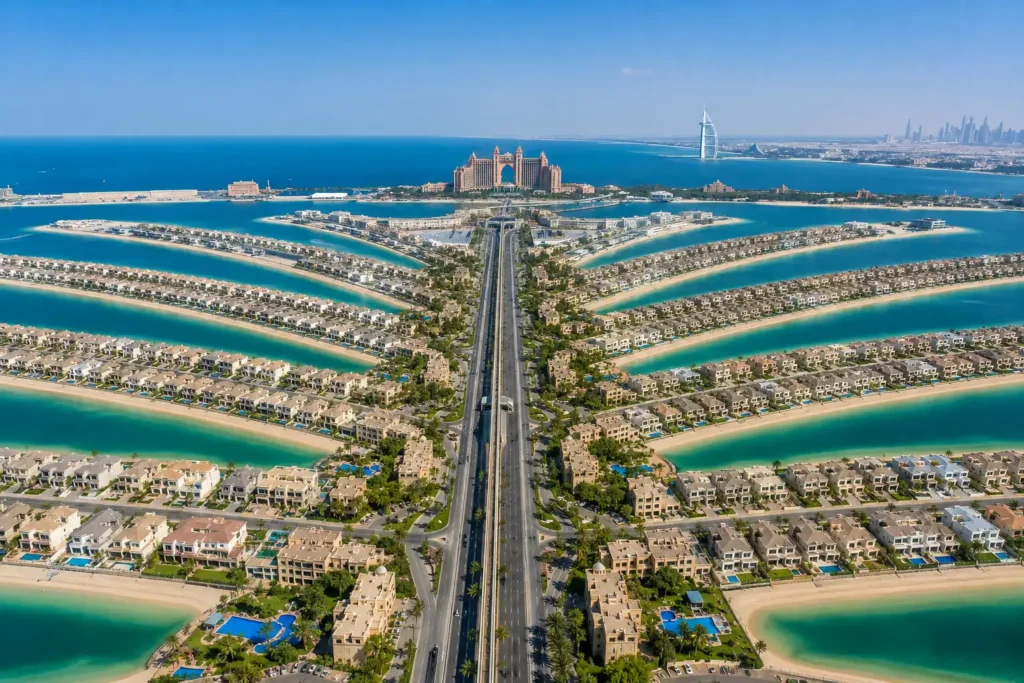
Furnished apartments on Palm Jumeirah are the most expensive on this list by a clear margin. A 1 bedroom can run past AED 21,000 and a 2 bedroom past AED 56,000. Most furnished apartments here sit in serviced residences and hotel-branded buildings rather than standard rental towers.
You’re paying for beach access, Atlantis on your doorstep, and a level of privacy you don’t get anywhere else in the city. That lifestyle carries a real cost elsewhere. No direct metro, a 25 to 35 minute drive to Downtown, and daily costs like groceries and cabs that run higher than the rest of Dubai. People choose this address for lifestyle over commute, not the reverse.
JVC
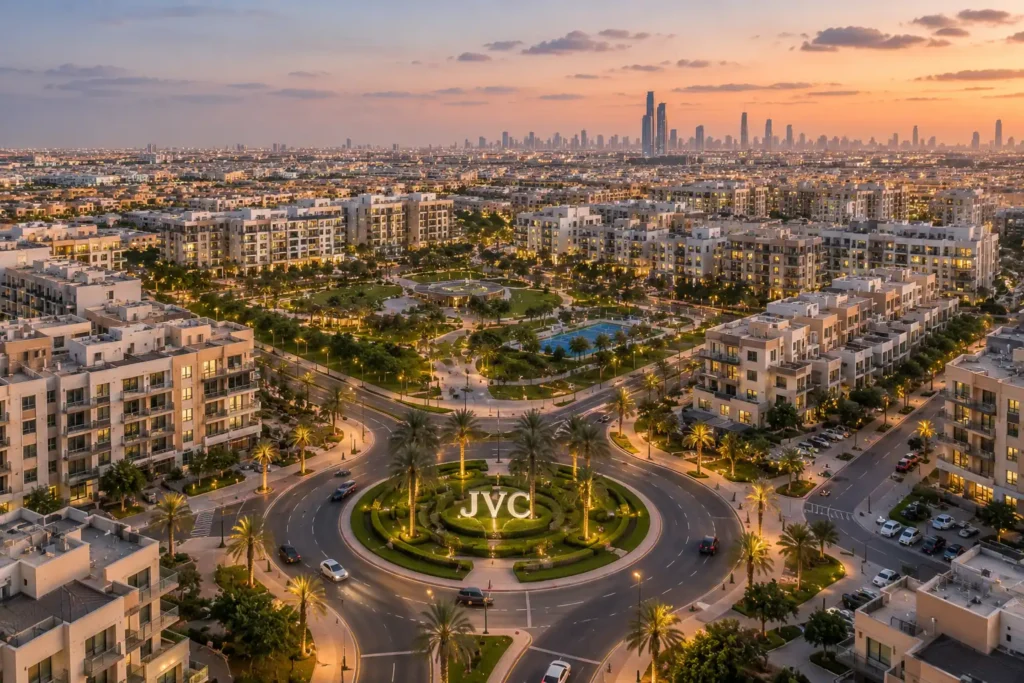
A furnished studio in JVC can run anywhere from about AED 2,800 to AED 12,900 a month, one of the wider spreads on this list. A handful of newer towers now price close to what you’d pay in Downtown, which explains the spread. A 1 bedroom is more predictable, usually landing around AED 4,000 to 8,000, roughly half of what the same size costs in Downtown Dubai. Such a wide gap between studio and 1 bedroom pricing is a big reason JVC stays one of the highest volume addresses for furnished listings in the city.
It sits centrally enough that Marina, JLT, and the Media City corridor are all 10 to 20 minutes away. There’s no direct metro station of its own though, and the airport itself runs about 28 minutes. Care more about budget than walking distance to a landmark? Shop around a bit for the right building, and the math usually works out best here.
Dubai Hills Estate
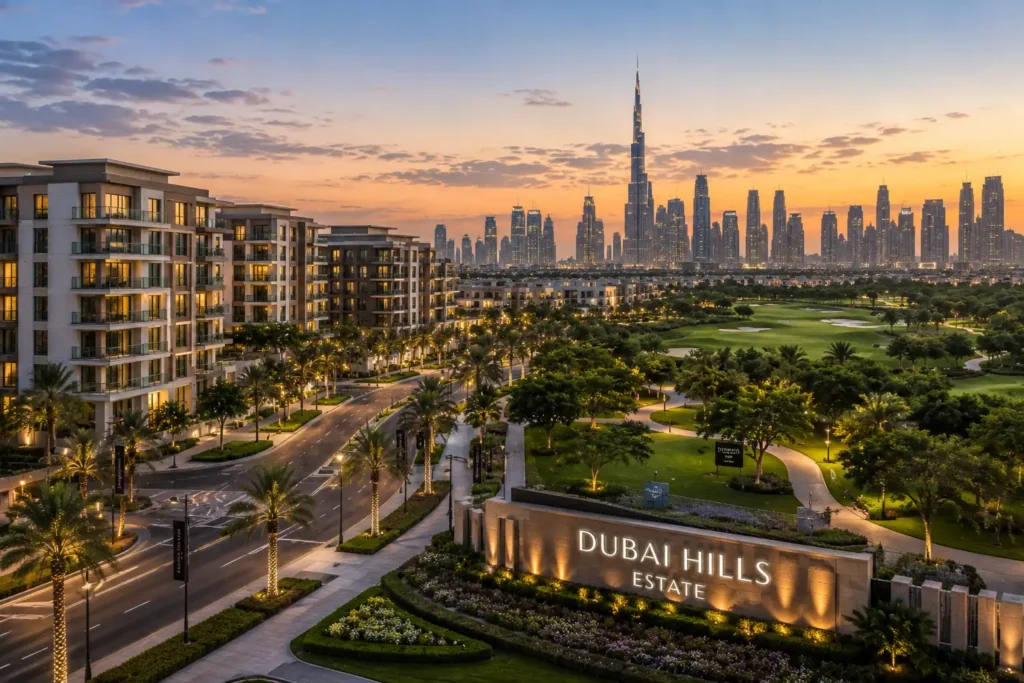
Dubai Hills Estate is built around a golf course and Dubai Hills Mall. Its pricing sits between the two, closer to Business Bay for 1-bedrooms and where studios start, closer to JVC for 2-bedrooms and how high studios can climb. Space, greenery, and school access are the draw here, rather than nightlife or a landmark on your doorstep.
It suits families and longer stays more than short furnished lets. Downtown and the Marina corridor sit about 20 minutes away by car, and the airport is roughly 24 minutes out.
Bur Dubai
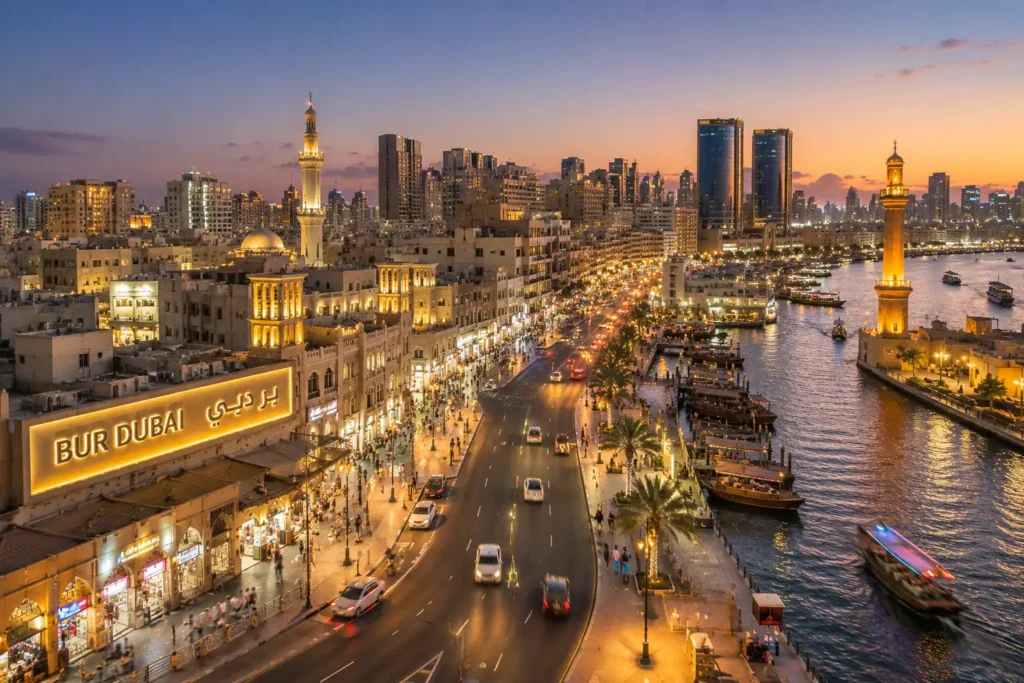
Bur Dubai sits closer to the airport than anywhere else on this list, about 11 minutes. Studio rents here tend to undercut Downtown at every price point, though the priciest Bur Dubai studios can edge past Business Bay’s ceiling. 1 bedroom pricing is a different story: the range now stretches from around AED 2,650 all the way to AED 18,500. Some of the newer buildings here practically out-price a comparable unit in Business Bay, and even exceed Downtown’s own ceiling. Worth checking the specific building rather than assuming the area is automatically the cheap option.
This is old Dubai. Dubai Creek, the Gold Souk, and the Spice Souk are all a short walk or a quick taxi away. Renters who want a different, more local feel than the glass tower districts tend to gravitate here, plus it means easy access if you’re flying in and out often.
Monthly vs Annual Furnished Apartment Rentals
Monthly furnished apartments in Dubai cost more than the same unit on an annual rent lease as a rule, though the premium varies sharply by area and building. It ranges from close to nothing at the entry level in areas like Bur Dubai and Marina, up to 20-30% or more in tightly supplied buildings. Take a JVC studio renting for around AED 65,000 a year. Renting it monthly instead works out to roughly AED 6,500 to 7,000 a month, which adds up to AED 78,000 to 84,000 over twelve months for the exact same unit.
Three things come with that premium. No post-dated cheques, DEWA and WiFi already bundled into the price, and the ability to leave with 30 days notice instead of being locked into a year. Annual rent leases flip all three. Landlords usually ask for one to four post-dated cheques upfront, and you’ll need to register the tenancy on Ejari yourself. Breaking the lease early tends to mean losing part of your deposit or negotiating an exit with the landlord.
The math is simple once you know your timeline. Staying under about ten months, monthly rent almost always works out cheaper once you account for the deposit and hassle of an annual contract you’d have to break early. Past that, the annual rate pulls ahead, and the savings get bigger the longer you stay.
Short-Term vs Long-Term Furnished Apartments
Short-term furnished rentals in Dubai, anything from a few days up to around six months, run under a completely different legal setup than an annual lease. The property needs what’s commonly still called a DTCM permit, which Dubai’s Department of Economy and Tourism (DET) now issues. It has to meet holiday-home standards that inspectors check in person before authorities grant the licence: proper bed linens, towels, kitchenware, a fire extinguisher, and a smoke detector.
This isn’t optional paperwork. Listing a short-term furnished apartment without that licence is illegal. Dubai has actively pulled unlicensed listings off platforms like Airbnb and Booking.com, with fines on top for the operator. As a renter, that works in your favour. A licensed short-term rental means someone has already checked the unit and the furnishing standard, which is more than you can say for a lot of long-term listings.
Long-term furnished leases, the kind you register on Ejari, fall under Dubai’s standard tenancy law instead. Real protections come with that: fixed notice periods before a landlord can raise your rent or ask you to leave. You also get a proper paper trail if a dispute ends up in front of the Rental Dispute Settlement Centre. A short-term stay skips all of that, leaving you covered by whatever’s written in your booking agreement and nothing else. Fine for a few weeks, but worth thinking about if a “short-term” stay quietly stretches past a few months without you ever switching to a proper Ejari-registered lease.
Average Rental Prices of Furnished Apartments
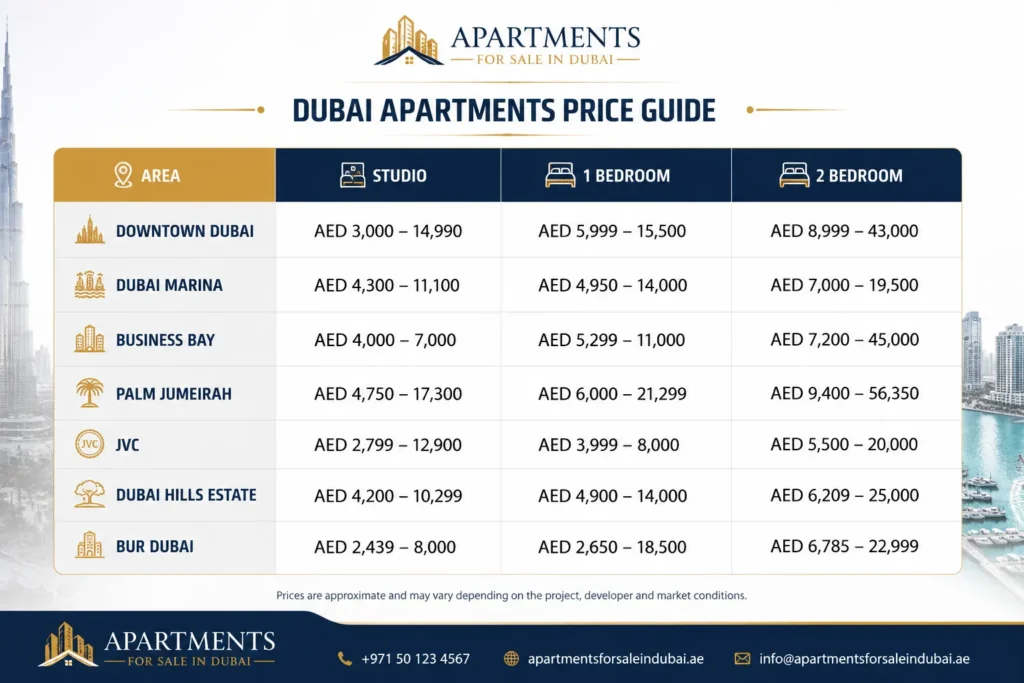
Rent for a furnished apartment in Dubai depends more on the area than on the furnishing itself. The table below pulls together studio, 1 bedroom, and 2 bedroom pricing across all seven areas in this guide. We checked it against live listings on Bayut, Property Finder, and Dubizzle. For each platform, we compared the lowest and highest asking prices on the first page of results (standard annual lease, shown as a monthly figure):
| Area | Studio | 1 Bedroom | 2 Bedroom |
| Downtown Dubai | AED 3,000 – 14,990 | AED 5,999 – 15,500 | AED 8,999 – 43,000 |
| Dubai Marina | AED 4,300 – 11,100 | AED 4,950 – 14,000 | AED 7,000 – 19,500 |
| Business Bay | AED 4,000 – 7,000 | AED 5,299 – 11,000 | AED 7,200 – 45,000 |
| Palm Jumeirah | AED 4,750 – 17,300 | AED 6,000 – 21,299 | AED 9,400 – 56,350 |
| JVC | AED 2,799 – 12,900 | AED 3,999 – 8,000 | AED 5,500 – 20,000 |
| Dubai Hills Estate | AED 4,200 – 10,299 | AED 4,900 – 14,000 | AED 6,209 – 25,000 |
| Bur Dubai | AED 2,439 – 8,000 | AED 2,650 – 18,500 | AED 6,785 – 22,999 |
These are standard annual rent rates shown per month. Monthly furnished apartments and short-term stays tend to run above these numbers. The premium ranges from close to nothing in areas like Bur Dubai and Marina to 20-30% or more in tightly supplied buildings. That’s the same range covered in the monthly vs annual section above.
Amenities Included in Furnished Apartments

Every furnished apartment in Dubai comes with the basics: a bed, sofa, dining table, a fully equipped kitchen with a fridge, stove, and cookware, and built-in wardrobes. Most buildings add a swimming pool, gym, covered parking, and 24 hour security on top of that, plus a balcony on most units above ground floor.
Whether your quoted price already includes utilities is the real variable. On a monthly furnished apartment, the rent often includes DEWA (electricity and water), WiFi, and district cooling, which is part of why monthly rates run higher than annual ones. On a standard annual rent lease, “furnished” simply means the furniture stays. You still open your own DEWA account and pay a refundable AED 2,000 deposit plus about AED 110 in activation fees. The monthly bill lands separately, usually AED 300 to 600 for a studio and AED 400 to 850 for a 1 bedroom, more in summer when the AC runs constantly.
One extra cost surprises a lot of new tenants: district cooling. Many buildings in areas like Business Bay, Downtown, Marina, and DIFC run on it instead of a standard AC unit, billed separately by a provider like Empower or Tabreed. Even with the AC off, a fixed monthly charge for simply being connected still applies in most cases. That’s often AED 150 to 300 for a 1 bedroom on top of your DEWA bill. Always ask whether a listing is “chiller free” before signing, since that one detail changes your real monthly cost more than almost anything else here.
Who Should Rent Furnished Apartments?
Four groups make up most of the demand for furnished apartments in Dubai. The reason changes from group to group. Different renters have different priorities: people on work contracts avoid a wasted furniture purchase, families rarely find it worth it, students want a low-commitment share, and business travelers need more room than a hotel gives them.
Professionals
Professionals on a one to two year work contract are the single biggest group renting furnished apartments in Dubai. Buying AED 15,000 to 35,000 of furniture for a job that could continue in a different building, or end with six months’ notice, rarely makes sense.
A furnished lease also makes it cheap to change your mind. Maybe the commute from JVC turns out worse than expected. Maybe Business Bay traffic gets old fast. Either way, walking away from a furnished lease costs a lot less than one where you’ve already bought a sofa and a bed frame.
Families
Families rent furnished far less often than singles or couples, for a practical reason: a standard furnished apartment comes set up for one or two adults. Cots, high chairs, and bunk beds for two kids sharing a room usually aren’t part of the package.
It still makes sense for a short bridge though: the first few months after arriving in Dubai, while you look for a bigger unfurnished apartment or decide which school catchment best works for your family. Past that, most families are better off buying their own furniture and signing unfurnished, especially once you’re looking at a 2 bedroom furnished apartment, where the annual premium adds up fast.
Students
Students studying in Dubai are usually here for a semester or a year at a time. That short, uncertain timeline makes furnished renting an ideal fit. Splitting a 2 bedroom furnished apartment with a roommate often works out cheaper per person than a studio alone. It also avoids the upfront cost of furnishing a place you’ll leave when the term ends.
Foreign students can rent under the same tenancy rules as any other expat, provided they have a valid passport, visa, and the required documents. Whether the building allows sharing is worth checking before signing anything, since some landlords cap occupancy per bedroom.
Business Travelers
A business trip that runs longer than a couple of weeks but shorter than a year sits in an awkward gap. It’s too long for a hotel to make financial sense, and too short to justify an annual lease. A furnished monthly rental fills that gap well, giving you a kitchen, laundry, and actual living space at a fraction of what an extended-stay hotel charges for the same weeks.
Where you should ultimately stay depends on whether you’re in Dubai for meetings or for downtime, which the next section breaks down.
Best Areas Based on Your Purpose of Visit
The area that works for a business trip is rarely the one that works for a vacation. In Dubai the gap between the two is bigger than in most cities, since the business districts and the tourist spots sit in different parts of town.
Best Areas for Business Travelers & Office Commute
If your meetings are in DIFC, Downtown Dubai or Business Bay put you five minutes from the office and about 16 minutes from the airport. That matters if you’re flying in and out for short trips. If your work is in Internet City, Media City, or along the JLT corridor instead, Dubai Marina or JVC cut that commute down to 10 to 20 minutes, though it costs you a longer drive to the airport.
The airport itself sits at almost exactly the same distance from JVC and Marina, about 28 to 29 minutes either way. Pick based on where your office actually is, not which area sounds more convenient on a map.
Best Areas for Tourists & Vacationers
Downtown Dubai puts Burj Khalifa, Dubai Mall, and the Dubai Fountain within walking distance of each other. If your trip is short and you want to see the most in the least travel time, this is the base that saves you the most hours. Dubai Marina works better if beach time matters more than landmarks, with Marina Walk, JBR Beach, and Palm Jumeirah all under 15 minutes away.
Bur Dubai and Deira suit a completely different trip. Dubai Creek, the Gold Souk, and old Dubai’s narrow streets sit a short walk apart. This area also happens to sit closest to the airport of anywhere on this list, useful if your stay is short and every hour counts.
Best Areas for Remote Workers & Digital Nomads
Dubai’s Virtual Working Programme lets remote employees and freelancers live here on a renewable one year visa without needing a local employer. For that kind of multi-month stay, JVC or the JLT side of Dubai Marina usually make more sense than Downtown. You’re not paying a premium for airport proximity or beach views you’ll use once a week at most. The lower rent adds up over several months in a way it doesn’t over a two week trip.
WiFi reliability and a coworking space nearby are what actually matter for this group. Both JVC and the Internet City/Media City corridor next to Marina cover that without the Downtown price tag.
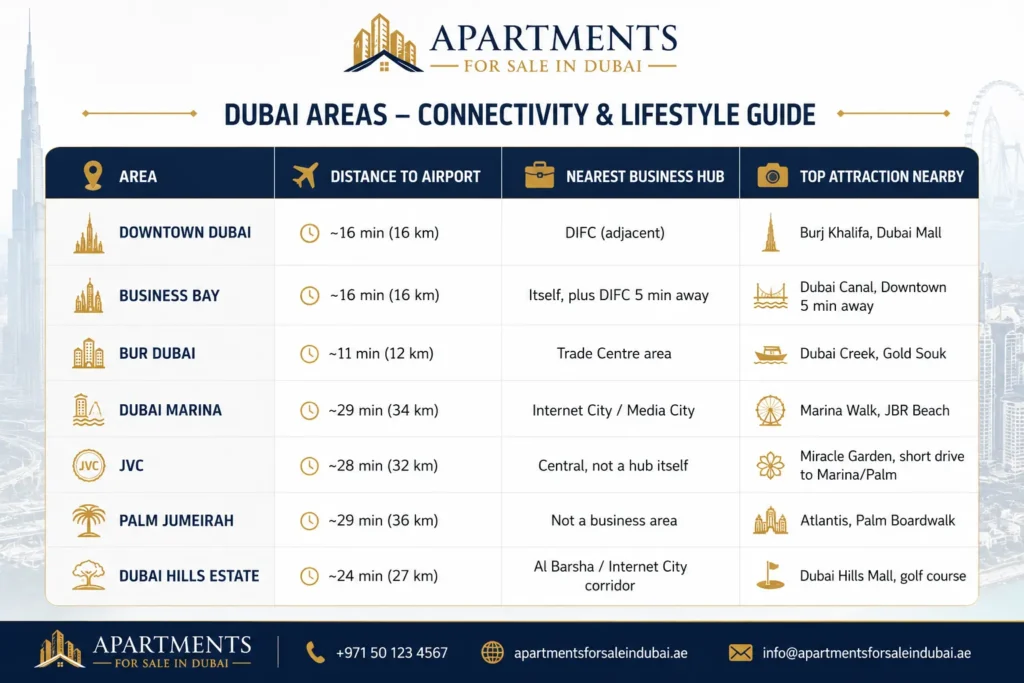
Here’s how the numbers stack up for commute planning, distances and drive times pulled from Google Maps:
| Area | Distance to Airport | Nearest Business Hub | Top Attraction Nearby |
| Downtown Dubai | ~16 min (16 km) | DIFC (adjacent) | Burj Khalifa, Dubai Mall |
| Business Bay | ~16 min (16 km) | Itself, plus DIFC 5 min away | Dubai Canal, Downtown 5 min away |
| Bur Dubai | ~11 min (12 km) | Trade Centre area | Dubai Creek, Gold Souk |
| Dubai Marina | ~29 min (34 km) | Internet City / Media City | Marina Walk, JBR Beach |
| JVC | ~28 min (32 km) | Central, not a hub itself | Miracle Garden, short drive to Marina/Palm |
| Palm Jumeirah | ~29 min (36 km) | Not a business area | Atlantis, Palm Boardwalk |
| Dubai Hills Estate | ~24 min (27 km) | Al Barsha / Internet City corridor | Dubai Hills Mall, golf course |
Renting vs Buying: Which Fits Your Situation in Dubai?
Staying under about five years, renting is almost always the better move financially in Dubai. The average renter who eventually buys does so after 4.8 years. That gap exists for a reason. Transaction costs on a purchase, the 4% DLD fee, agency fees, and registration, take time to earn back against what you’d have paid in rent over the same stretch.
Buying starts making sense past that point, especially through an off-plan purchase, where developers like Emaar, DAMAC, Sobha, and Nakheel spread payments across a plan that runs well past handover. You’re not paying the full price upfront the way a resale purchase demands. The Dubai Land Department’s 2025 annual report backs this up. Total transactions reached AED 917 billion, up 20% from 2024, and off-plan sales made up over 60% of all residential deals.
Before committing to any off-plan purchase, confirm that the Dubai Land Department has registered the project. And check that the developer’s escrow account is compliant so your payments sit in a project-specific account rather than going straight to the developer. Then look at what that developer has actually delivered before, beyond whatever they’re marketing today.
One more practical incentive is worth knowing about: a property purchase above AED 2 million qualifies you for the UAE’s 10 year Golden Visa. That’s why renters who are already certain they’re staying in Dubai long term often start looking at buying well before that 4.8 year average.
Things to Check Before Renting
Anyone can rent in Dubai regardless of nationality, including Americans, since no nationality-based restrictions apply to residential tenancy here. Your visa status is what actually determines whether you can sign a lease, not your passport.
For a standard annual rent lease, you need a valid UAE residence visa and an Emirates ID, since both are required to register the tenancy on Ejari and activate DEWA. If you haven’t got residency yet, an annual lease simply isn’t an option, not because you’re foreign, but because Ejari and DEWA won’t process it without an Emirates ID. A serviced apartment or short-term furnished apartment fills that gap instead, needing nothing but a passport. Most people moving to Dubai take advantage of this. They rent short-term for the first month or two while their residency visa and Emirates ID come through, then switch to an annual lease once the paperwork lands.
Once you have residency, you’ll need a passport, your UAE residence visa, an Emirates ID, and proof of income. Employees can use a salary certificate or employment contract; the self-employed need a trade licence and recent bank statements instead. Landlords also ask for post-dated cheques covering the rent. Some developments, including parts of Dubai Marina and Downtown Dubai, require a separate move-in permit that can take up to five days to process. It’s worth confirming that early rather than at the last minute.
On spotting a legitimate listing: ask for the agent’s RERA ORN number and check it through the Dubai REST app before sending any money. Never wire a deposit before viewing the unit in person or over video. Insist on Ejari registration once you sign, since a landlord who resists registering the contract officially is usually avoiding something.
Thinking About Buying Instead of Renting?
Everything above is informational, a breakdown of how Dubai’s furnished rental market works. We don’t broker rentals ourselves. Our business is off-plan apartment sales. This guide exists to help you work out whether renting still makes sense for your timeline, or whether it’s worth looking at buying instead. If the numbers above have you leaning toward buying, or you’re simply testing Dubai out before deciding, this is where our actual service comes in. Before we list any off-plan project on this site, we register it with the Dubai Land Department and check its RERA compliance and escrow account status. You’re not the one doing that verification after you’ve already fallen for a floor plan.
Working directly with these developers means we can walk you through the real payment plan instead of the brochure version. We can also cover what happens if handover slips, and what resale or rental yield realistically looks like once you’ve got the keys. None of this costs you anything extra. Buyer-side commission on off-plan sales is paid by the developer, not the purchaser, so getting that guidance before you sign doesn’t change what you’re paying.
Frequently Asked Questions
Q1: Can Foreigners Rent Furnished Apartments in Dubai?
Yes. No nationality restrictions apply to renting in Dubai, and foreigners make up the majority of tenants in the city. Eligibility comes down to your visa status rather than your nationality. You need a UAE residence visa and Emirates ID for a standard annual rent lease, while short-term and serviced apartments only ask for a passport.
Q2: Can Americans Rent Apartments in Dubai?
Yes, on the same terms as any other nationality. Dubai’s rental market doesn’t restrict tenancy by country of origin, so an American renter goes through the identical Ejari and documentation process as anyone else.
Q3: What Documents Do I Need to Rent a Furnished Apartment in Dubai?
For an annual lease: passport, UAE residence visa, Emirates ID, and proof of income, either a salary certificate or a trade licence and bank statements if you’re self-employed. For a short-term or monthly furnished rental, a passport covers it in most cases.
Q4: What’s Included in a Fully Furnished Apartment Rental in Dubai?
Furniture, a fully equipped kitchen, and fitted wardrobes as standard, plus building amenities like a swimming pool, gym, and parking. Whether utilities and WiFi are included depends on whether it’s a monthly or annual lease.
Q5: What’s the Average Rent for a Furnished Studio in Dubai?
Roughly AED 2,439 to 17,300 a month depending on area, from JVC or Bur Dubai at the low end to Palm Jumeirah at the high end.
Q6: How Much Does a 1-Bedroom Furnished Apartment Cost in Dubai?
Between AED 2,650 and 21,299 a month. JVC is the most consistently affordable, with the lowest ceiling of any area on this list, while Palm Jumeirah sits at the very top. Bur Dubai is the wildcard: its cheapest units undercut everywhere else, but its priciest 1-bedrooms actually climb past Downtown’s own ceiling.
Q7: What’s the Difference Between a Studio and 1BR in Furnished Rentals?
A studio is one open room for living and sleeping with a separate bathroom, usually 350 to 600 square feet. A 1 bedroom furnished apartment adds a separate bedroom and typically a balcony, which is why it costs more but suits couples better than a studio does.
Q8: Which Dubai Neighborhoods Have the Most Furnished Rentals?
JVC and Business Bay carry the highest volume of furnished listings in the city, followed by Dubai Marina. Downtown Dubai and Palm Jumeirah have fewer furnished options relative to their total housing stock.
Q9: Which Areas of Dubai Have Affordable Furnished Apartments?
JVC and Bur Dubai have the lowest entry prices in this guide. For JVC, a 1 bedroom runs at roughly half of what the same size costs in Downtown Dubai. Bur Dubai’s entry price is even lower, but its range runs the widest of the two. A handful of newer buildings there now price above Downtown’s own ceiling, not just close to it.
Q10: Are There Furnished Apartments With Metro Access in Dubai?
Yes. Downtown Dubai, Business Bay, and Dubai Marina all sit on or near a metro line. JVC and Palm Jumeirah are the exceptions among the areas covered here. Neither has a direct metro station, so residents rely on buses or taxis to reach the nearest ones.
Q11: Is Short-Term Furnished Rental Legal in Dubai?
Yes, provided the unit holds a DTCM permit through Dubai’s Department of Economy and Tourism and meets holiday-home furnishing standards. An unlicensed short-term listing is illegal and can be pulled from platforms like Airbnb.
Q12: Can I Rent a Furnished Apartment for Just One Month or Month-to-Month in Dubai?
Yes, this is one of the most common ways furnished apartments get rented in Dubai. Most buildings that offer monthly furnished apartments don’t require a minimum beyond 30 days, though pricing usually gets noticeably cheaper the longer you commit within that monthly structure.
Q13: Can Business Travelers Get Weekly or Nightly Furnished Rentals in Dubai?
Yes, through DTCM-licensed serviced apartments and hotel apartments, which operate on the same permit system as short-term holiday rentals. These run closer to hotel pricing per night but include a full kitchen and living space a hotel room doesn’t.
Q14: What’s the Typical Deposit Amount for Furnished Apartments?
A security deposit of 10% of the annual rent is standard for furnished units, compared with 5% for unfurnished ones. It’s paid as a separate cheque on top of the rent itself. This is separate from the DEWA deposit of AED 2,000, which goes directly to DEWA rather than the landlord.
Q15: How Do Furnished Apartments Handle Damage and Security Deposits When Moving Out?
The landlord or property manager inspects the unit at move-out and deducts the cost of any damage beyond normal wear. The remaining deposit gets refunded, typically within a couple of weeks. Photos of the apartment’s condition at move-in are worth keeping specifically for this reason.
Q16: Can I Negotiate Rent on a Furnished Apartment in Dubai?
Yes, more so in 2026 than in the previous two years, as rent growth has moderated across most areas. You have the most room to negotiate on units that have sat listed for a while or in buildings with a lot of comparable inventory, like JVC.
Q17: Can I Break a Furnished Apartment Lease Early in Dubai?
It depends entirely on what your contract says, since Dubai tenancy law doesn’t set a universal penalty. Most annual contracts specify an early termination clause, commonly one to two months’ rent or forfeiting part of the deposit. Check that clause before signing, not after you need to use it.
Q18: What’s Included in the Rental Contract for Furnished Apartments?
The rent amount, payment schedule, the lease term, notice period for renewal or exit, and who’s responsible for maintenance. For it to be legally enforceable, it also needs to be registered on Ejari, regardless of whether the apartment is furnished or not.
Q19: Do Furnished Apartments Include Utilities and WiFi in Dubai?
Usually yes on a monthly furnished apartment, since DEWA and WiFi tend to come bundled into the rent. On a standard annual rent lease, furnished just means the furniture stays, and you set up DEWA separately yourself.
Q20: Are Furnished Apartments in Dubai Pet-Friendly?
It varies by building rather than by area, though JVC and Dubai Marina have a higher share of pet-friendly buildings than Downtown or Business Bay. Always confirm directly with the landlord or building management before signing, since policies aren’t standardized citywide.
Q21: What’s the Best Time to Rent a Furnished Apartment in Dubai?
For monthly and short-term furnished rentals, availability tightens and prices rise during peak tourist season, roughly November to February. Book outside that window and you’ll get more choice and better rates. For annual leases, timing matters less, though listings tend to pick up toward the end of summer as more people relocate for the new school and work year.
Q22: How Long Does It Take to Rent a Furnished Apartment in Dubai?
For a monthly furnished apartment, you can often move in the same day or the next. There’s no Ejari or DEWA setup to wait on, just a passport and payment. For a standard annual rent lease, viewing to signing generally takes 1 to 3 days once you’ve found the unit. If you don’t have your Emirates ID yet, though, add however long that takes, since the lease can’t finalize without it.
Q23: How Do I Find Monthly Furnished Apartments in Dubai?
Property Finder, Bayut, and Dubizzle all have filters specifically for furnished and monthly listings, and serviced apartment operators list directly on their own sites too. Cross-check the same building across two or three of these before committing, since prices for an identical unit can vary more than you’d expect between platforms.
Q24: What’s the Difference Between Serviced Apartments and Furnished Rentals?
A serviced apartment comes with hotel-style services like housekeeping and sometimes a front desk, is billed like a hotel stay, and only needs a passport, no Ejari or Emirates ID. A standard furnished apartment, monthly or annual, gives you the furniture but no ongoing staff, and an annual one specifically requires Ejari and residency.
Q25: What Are Common Problems With Furnished Apartments in Dubai?
The furniture itself is usually the issue. It’s often lower quality than what’s shown in listing photos, and you’re liable for damage to pieces you didn’t choose. If you already own furniture, there’s nowhere to put it either. Furnished units are also simply fewer in number than unfurnished ones on the market, so your choice of building narrows.
Q26: How Do I Know If a Furnished Apartment Listing Is Legitimate?
Ask for the agent’s RERA ORN number and verify it through the Dubai REST app before paying anything. Never wire a deposit before viewing the unit in person or over video, and insist on Ejari registration once you sign, since a legitimate landlord won’t resist that step.
Q27: Do I Need Travel Insurance or Tenant Insurance for Furnished Rentals?
Neither is legally required, but both are worth having. Travel insurance covers you for the trip itself, not the apartment. The furniture in a furnished unit belongs to the landlord, after all. Tenant contents insurance protects you from paying out of pocket if something gets damaged or your belongings are stolen.
Q28: How Do Furnished Apartments Handle Maintenance and Repairs?
The landlord or property manager covers repairs to the furniture, appliances, and the unit itself, since it’s their property. You’re expected to report problems promptly rather than wait. On a serviced apartment, routine cleaning is usually included; on a standard furnished lease, it isn’t, and that’s on you.
Q29: Which Area is Best for a Furnished Apartment Near Dubai International Airport?
Bur Dubai sits closest at about 11 minutes, with Downtown Dubai and Business Bay tied right behind at 16 minutes each. Dubai Hills Estate is a middle ground at around 24 minutes, while JVC, Dubai Marina, and Palm Jumeirah all sit furthest out, in the 28 to 29 minute range.
Q30: What’s the Best Area to Rent a Furnished Apartment for Business Trips in Dubai?
Downtown Dubai or Business Bay if your meetings are in DIFC. Dubai Marina or JVC if your work is in Internet City, Media City, or along JLT instead. Let your actual commute decide, since a neighborhood’s reputation won’t get you to a 9am meeting on time.
Q31: Can Digital Nomads Rent Furnished Apartments in Dubai?
Yes, through the UAE’s Virtual Working Programme, a renewable one year remote work visa that doesn’t require a local employer. JVC or the JLT side of Dubai Marina often make more financial sense for this group than Downtown, since you’re not paying a premium for proximity you won’t use daily.
Q32: Do I Need a Specific Visa to Rent a Furnished Apartment for Several Months?
No separate visa exists just for renting. Your immigration status just needs to cover the length of your stay. A standard tourist visa (30, 60, or 90 days depending on nationality) is enough for a short-term furnished stay within that window. If you’re staying longer, you need to either renew that visa or move to a proper residence visa, since the apartment itself has no visa requirement attached to it.