
Duplex Apartments for Sale in Dubai


BOOK AN APPOINTMENT
Duplex Apartments for Sale
Most people in Dubai walk past duplexes without even noticing them, honestly. Then they step inside one and it clicks. If you’ve been browsing duplex apartments for sale in Dubai for a while, you’ve probably noticed two things already: the good ones vanish fast, and the price per square foot tends to sit above what a regular apartment in the same building costs. There’s a reason for that gap. A duplex gives you villa-like space without giving up the convenience of tower living, and in a market that shifts every few months, that combination has aged pretty well.
Here’s what this guide actually covers. Current prices across the main areas, which neighborhoods are worth your time, bedroom sizing, the investment math, the rules for foreign buyers, financing, and the fees nobody puts in the headline listing. Anything that moves with the market, yields, DLD charges, mortgage rates, I’ve pulled current 2026 numbers for rather than rounding off something that sounds nice.
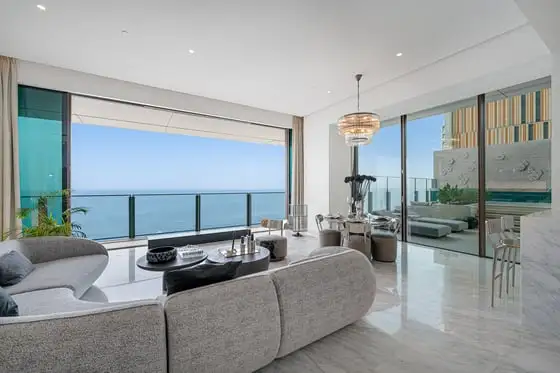
What Is a Duplex Apartment?
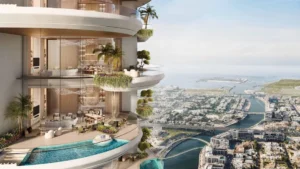
One unit, two floors, a staircase connecting them inside your own front door. That’s really it. Living and dining space usually sit downstairs, bedrooms upstairs, though plenty of buildings flip that around depending on the design. You get a split that a normal flat can’t offer, minus the price tag and upkeep that comes with an actual villa.
Most Dubai duplexes cluster near the top of towers, sometimes marketed as sky homes if the developer’s feeling fancy. A few buildings are designed with duplexes running through several floors. Others might tuck away just three or four such units among hundreds of regular apartments, and that second scenario is honestly more common than people expect. It’s also why finding a decent one takes more digging than finding a standard flat.
Why Buy a Duplex in Dubai?
Ask ten agents why duplexes sell, and most will say the same thing: separation. You can have guests over downstairs while someone naps upstairs, and neither one really bothers the other. A lot of these units also come with a double-height living room, which changes the feel of the place before you’ve moved a single piece of furniture in.
That said, I wouldn’t oversell it. Service charges on duplexes usually run higher than a same-sized regular apartment, and internal stairs aren’t for everyone. Small kids, older parents, anyone with mobility concerns, they might genuinely prefer a single floor. So no, a duplex isn’t the objectively “better” choice. It fits certain households really well and others not so much.
On the investment side, the broader picture looks decent without being a slam dunk. Dubai’s residential transactions hit 42,800 in Q1 2026 alone, up 18% year-on-year, and that pace has more or less held through the rest of the year. Duplexes and penthouses together still make up under 3% of total sales, so supply stays genuinely tight. Tight supply usually props up prices better than average, at least for units in well-managed buildings. None of that saves you from overpaying though. A duplex bought at a fair price in a solid community tends to hold up long term; the same layout bought at a premium in an oversupplied off-plan project carries all the usual risks.
Families, in particular, seem to gravitate toward this layout. Splitting kids’ rooms from the main living area by floor is just practical, and when you throw in the parks, nurseries, and schools that a lot of Dubai’s master communities now have, areas like JVC or Dubai Hills start making a lot of sense for that buyer profile.
What Do Duplex Apartments Actually Cost?
Numbers here swing a fair bit by area. On the cheaper end, JVC has duplex listings starting around AED 2.5 million. On the other end, Marina and Palm Jumeirah routinely blow past AED 10 million for the bigger units. For some context, apartments across Dubai average somewhere between AED 1,950 and 1,970 per square foot in 2026, and duplexes tend to trade above that simply because there are fewer of them, and they’re often sitting in prime waterfront spots. Palm Jumeirah specifically can climb to AED 3,500–4,000 per square foot.
Worth keeping in mind: penthouses and large duplexes combined make up less than 3% of all residential transactions citywide. That scarcity is a big part of why prices in this category don’t soften much, even when the wider market cools off.
As for direction, it really depends which part of the city you’re looking at. Business Bay has posted some of the sharpest price growth of any community this year. Downtown still sits at the top of the per-square-foot list by a comfortable margin. Marina’s climbing too, just more gradually than the newer growth areas. None of that is set in stone, so pull current DLD transaction data before locking anything in. These figures genuinely move month to month.
If you’re after 2 bedroom duplex apartments for sale in Dubai, that’s probably the most searched size, and it’s not hard to see why. Big enough for a small family, small enough that the rental numbers still work for an investor. A 2 bedroom duplex for sale in Dubai typically runs AED 2.5–4 million, with waterfront units well above that.
And if budget’s the priority over location, cheap duplex apartments for sale in Dubai realistically means JVC, Arjan, or parts of Dubai South, not Marina, no matter how a listing tries to spin it. Even in these more affordable pockets, a duplex still costs more than a regular flat of the same size, since you’re paying for the extra floor either way. I’ll skip naming “the cheapest flat in Dubai” here since that title turns over too fast to be worth printing.
Read more
Best Areas for a Duplex
There’s no universal “best area” answer, and anyone claiming otherwise is probably trying to sell you something. It really comes down to what you’re after.
Marina works if waterfront living and rental demand matter to you. Downtown if prestige and proximity to Burj Khalifa and Dubai Mall are the priority. Business Bay if you’re chasing growth. JVC if affordability and family space matter more than the address on the title deed.
Area | Typical Positioning | Lifestyle | Investment Appeal | Connectivity |
Dubai Marina | Waterfront, mid-to-high-end | Beach, dining, nightlife | Strong rental demand, ~5.6% ROI | Metro, tram, water taxi |
Palm Jumeirah | Ultra-prime waterfront | Resort-style, private beaches | Highest price stability | Monorail, road links |
Downtown Dubai | Prime, landmark | Burj Khalifa, Dubai Mall | Premium pricing, strong resale | Metro, central location |
Business Bay | Mixed-use, fast-growing | Urban, business-adjacent | Leading price growth in 2026 | Metro, close to DIFC |
JVC | Mid-market, affordable | Family communities, parks | Strong yields, high liquidity | Road access, growing metro links |
Dubai Islands | Emerging waterfront | New beachfront lifestyle | Early-stage growth potential | Developing infrastructure |
Marina currently averages roughly AED 2,188 per square foot with an ROI close to 5.6%. Business Bay runs a touch higher, near AED 2,547, with slightly better yield. Downtown, no surprise, tops the pricing table across the board.
Sizes: 1 Bedroom Through Sky Villas
The 1-bedroom is the investor’s entry point, common in Business Bay and JVC. The 2-bedroom is what most people actually end up buying since it balances price against livability better than anything else on the list. 3-bedroom units tend to go to families, often with a maid’s room and bigger terraces thrown in. 4-bedroom duplexes shift into premium territory, mostly in waterfront or branded towers. And at the very top sit the larger duplexes and sky villas, which routinely cross AED 10 million.
Duplex vs Everything Else
Against a regular apartment, it’s a vertical space question. Two connected floors, sometimes a double-height ceiling, versus everything crammed onto one level. You pay more per square foot for the duplex, but it feels closer to a small house than a flat, and that’s the whole selling point.
Against a townhouse, things shift a bit. A townhouse stands alone or shares one wall, sits on its own small plot, and opens straight onto the street. A duplex lives inside a bigger building surrounded by shared amenities. Want a private garden and ground access? Go townhouse. Want a pool, gym, and security desk downstairs? Duplex wins that one.
Against a villa, it’s mostly privacy and land traded for a lower price. Villas give you total independence, no shared walls, no shared lobby. Duplexes give some of that up in exchange for a much smaller price tag and access to a building’s facilities. If you can live without a private garden, a duplex gets you most of the villa feeling anyway.
And against a penthouse, this is where people mix things up constantly. Duplex is the layout, two floors connected internally. Penthouse is the position, usually the top floor with a view to match. Plenty of penthouses happen to be duplexes. Not every duplex is a penthouse, and not every penthouse spans two floors, so the terms aren’t really interchangeable.
Property Type | Space | Privacy | Maintenance | Typical Buyer |
Duplex Apartment | High for an apartment | Moderate | Building-managed | Families, upgraders |
Townhouse | Moderate, with small plot | High | Owner + community managed | Families wanting ground access |
Villa | Highest | Highest | Fully owner-managed | End-users, luxury buyers |
Penthouse | Varies (often duplex) | High | Building-managed | Luxury, status-driven buyers |
Is It Actually a Good Investment?
Yields across Dubai’s busiest communities have held up reasonably well. Marina sits around 5.5–7.2% gross for long-term leases, and short-term rentals can push well past that when someone’s actually managing them properly. Business Bay looks similar. JVC has historically ranked among the stronger yield performers, mainly because entry prices stay lower relative to what units rent for. Duplex units specifically tend to command rents at the top of whatever range their building falls into, since tenants who can afford the extra space usually will pay for it.
Working out your own return isn’t complicated math: divide annual rental income by purchase price, multiply by 100, and that’s your gross yield. Want something closer to real life? Subtract service charges, maintenance, and financing costs first. And please, use actual rents from comparable units in your specific building, not some citywide average that has nothing to do with your tower.
On which neighborhoods offer the strongest case, it splits by what you’re chasing. Business Bay and Marina lead on liquidity and rental demand. JVC leads on raw yield because entry prices are lower there. Palm Jumeirah and Downtown trade some yield for stronger long-term value retention. Which one’s “better” really depends on whether you want cash flow now or a decade-long hold.
Nobody can time this market with any real precision, and anyone who tells you they can is guessing. What the current numbers show: transactions are still climbing, supply in this category stays thin, and Dubai still has zero property tax, zero capital gains tax, and zero tax on rental income. Whether now works for you comes down to your own budget and financing far more than anything the broader market is doing.
Buying as a Foreigner
Non-UAE nationals have been able to hold full freehold title here since 2002, and that hasn’t changed since. Around 40 designated zones across the city allow foreign ownership, Marina, Downtown, Business Bay, JVC, Palm Jumeirah, and Dubai Islands among them. Full ownership means exactly what it sounds like: sell it, lease it, mortgage it, pass it down to your kids.
A US citizen can buy a duplex here with zero nationality-specific restrictions, and that goes for buyers from just about anywhere. No UAE residency visa needed either. A passport and the usual paperwork gets you through. A lot of these deals even get completed remotely through power of attorney, though financing as a non-resident does mean a thicker stack of documents than a resident buyer would have to deal with.
The actual paperwork for a foreign buyer: passport, signed Sale and Purchase Agreement, a No Objection Certificate from the developer, and if you’re financing, proof of funds plus a bank NOC. Start to finish, buying something ready-to-move-in usually takes two to six weeks.
Then there’s the Golden Visa angle. Cross AED 2 million in property and you currently qualify for a 10-year renewable Golden Visa, and yes, you can stack multiple properties to hit that number. Since April 2026, the minimum threshold for the shorter two-year investor visa got scrapped completely, so pretty much any freehold purchase opens that door now. There’s also a retirement visa for buyers 55+ holding at least AED 1 million in completed freehold property.
Actually Buying One
Documentation stays fairly predictable across the board: valid passport, signed Sale and Purchase Agreement (Form F for a resale), developer NOC, proof of payment. Financing adds a bank NOC, income documents, and a valuation report on top.
Picking the right unit takes more effort than picking the right price, though. Floor position, how the two levels actually connect and flow, natural light, the building’s age and general upkeep, current service charges, the developer’s track record, real rental demand in that exact tower, and how quickly comparable units have resold, all of it matters more over five years than the number on the listing. A pricier unit in a well-run building often works out cheaper long-term than a “bargain” buried under maintenance headaches.
Mistakes people keep making: skipping a walkthrough of both floors, underestimating service charges (which run higher on duplexes, always), trusting off-plan renderings a bit too literally, and not checking whether a developer actually delivers on time before signing a long payment plan.
Financing It
Both residents and non-residents can borrow from UAE banks, but the terms aren’t remotely equal. Non-residents currently see LTV around 50–65%, meaning you’re bringing 35–50% of the price as a down payment yourself. Resident expats get an easier deal, up to 80% LTV on ready properties under AED 5 million. Interest rates for non-residents currently sit somewhere between 4% and 6.5%, depending on the bank, your nationality, and how solid your financials look on paper.
Factor | New (Off-Plan) | Resale |
Handover | Future date, can slip | Immediate |
Payment structure | Staged developer plan | Lump sum or mortgage |
Inspection | Not possible pre-completion | Full walkthrough available |
Rental income | None until handover | Immediate, if tenanted |
Negotiation | Limited, fixed pricing | Usually more room |
Off-Plan or Ready, Which Carries More Risk?
Neither, automatically. It genuinely depends on the specific developer, how far along construction is, and how the payment schedule is set up. A well-capitalized, RERA-registered developer with a solid delivery history carries a completely different risk profile than some small outfit still selling from renderings. Before signing anything off-plan, check the escrow account and construction milestones directly through the Dubai Land Department. Don’t just take the sales office’s word for it.
What It Actually Costs to Own One
Purchase price is only half the story. There’s a real list of fees that catches a lot of first-timers off guard at closing.
|
Cost |
Typical Basis |
When Paid |
|
DLD transfer fee |
4% of purchase price |
At registration |
|
Trustee office fee |
AED 4,000–4,200 |
At registration |
|
Title deed issuance |
AED 250–580 |
At registration |
|
Mortgage registration |
0.25% of loan amount |
If financing |
|
Agency commission |
Typically 2% (resale) |
At transaction |
|
Service charges |
Building/community dependent |
Ongoing, annual |
The transfer fee is 4% of the purchase price. Legally it’s split 2% each between buyer and seller, but in practice, buyers in Dubai almost always end up paying the whole thing unless it’s negotiated in writing upfront. Add it all up and budget an extra 6–8% on top of the purchase price for registration and closing costs. It’s just how the system works here.
Everyday Living
Most duplex buildings offer the same basics you’d find in any Dubai tower: pools, gyms, covered parking, round-the-clock security. What sets the duplex units apart is usually the little extras, private terraces on more than one floor, sometimes access to a sky lounge in the nicer buildings. For families though, the unit itself is only part of the equation. Schools, nurseries, and clinics nearby matter just as much. JVC and Dubai Hills have built this kind of infrastructure out a lot over the past few years, while Marina and Downtown lean harder into walkable dining and retail than school access.
Renting It Out
Short-term rentals to tourists are allowed through a licensed setup via Dubai’s tourism authority, assuming your building’s owners’ association is okay with it, which not all of them are. Run properly, short-term rental can outperform a standard long-term lease by a solid margin, but it takes real effort: furnishing, managing guest turnover, staying compliant with the licensing rules.
Long-term leasing, on the other hand, means predictable income with almost no hands-on work. Sign a 12-month contract and get on with your life. Short-term can pay better, sure, but it demands active management, a bigger upfront furnishing spend, and some exposure to seasonal occupancy dips.
Why a Duplex, in the End?
If you’re still on the fence, the honest case is this: real separation between social and private space, more usable floor area than a comparable villa budget would buy you, terraces across more than one level in a lot of buildings, and a layout that appeals to both owner-occupiers and tenants alike, which keeps resale demand fairly healthy over time.
Final Thoughts
A duplex apartment for sale in Dubai isn’t for everyone, but for the right buyer it hits a spot nothing else quite reaches: more room and privacy than a standard flat, without the full cost and upkeep of a villa. Whichever area pulls you in, Marina’s energy, Downtown’s prestige, Business Bay’s momentum, or JVC’s value, the basics don’t change. Check the real numbers before committing to anything, understand what freehold ownership and the Golden Visa actually mean for your situation, and don’t take a rental yield claim at face value until you’ve verified it yourself.
Ready to see what’s actually available right now? Browse our current listings of duplex apartments for sale in Dubai and compare real pricing, layouts, and payment plans directly with our team.
Explore Apartments for Sale in Dubai by Locations
Recommended Searches
FAQS
Q1: Can foreigners buy duplex apartments in Dubai?
Ans: Yes, full freehold ownership in the designated zones, same rights a UAE national would have.
Q2: Can a US citizen buy a duplex in Dubai?
Ans: No restriction there, and you don’t need UAE residency either.
Q3: How much does a duplex apartment cost in Dubai?
Ans: Around AED 2.5 million to start in JVC, climbing past AED 10 million in Marina or Palm Jumeirah for the bigger units
Q4: What is the average rental yield for Dubai duplex apartments?
Ans: Roughly 5.5–7.2% gross on long-term leases in the top communities, with short-term rental sometimes doing better under good management.
Q5: Are duplex apartments good for families?
Ans: Genuinely yes. Splitting bedrooms from living space by floor works well for households with kids.
Q6: What is the difference between a duplex and a penthouse in Dubai?
Ans: Duplex is about the layout, two connected floors. Penthouse is about position, usually the top of the building. They overlap a lot but aren’t the same thing.
Q7: What is the difference between a duplex and a townhouse in Dubai?
Ans: A townhouse stands alone with its own plot and street access. A duplex sits inside a shared building with shared amenities.
Q8: Are duplex apartments available in Dubai Marina?
Ans: Yes, though supply stays thin compared to standard apartments in the same towers.
Q9: Which areas are best for buying a duplex in Dubai?
Ans: Marina and Business Bay for rental demand, Downtown for prestige and value, JVC if affordability tops your list.
Q10: Can I buy a duplex in Dubai without UAE residency?
Ans: Yes, no residency required at all.
Q11: What are the hidden costs of buying a duplex in Dubai?
Ans: The 4% DLD transfer fee, trustee charges, title deed fees, agency commission, and ongoing service charges. None of these are skippable.
Q12: Can I get a mortgage to buy a duplex in Dubai?
Ans: Yes, though non-residents should expect a 35–50% down payment versus lower requirements for residents.
Q13: Can I rent out my Dubai duplex to tourists?
Ans: Yes, with a proper short-term rental license and, where required, sign-off from the owners’ association.
Q14: What documents are required to buy a duplex in Dubai?
Ans: Passport, signed Sale and Purchase Agreement, developer NOC, and for financed deals, a bank NOC plus proof of funds.
Q15: Is an off-plan duplex a good investment in Dubai?
Ans: Depends entirely on the developer’s actual track record, not really on the off-plan label itself.
Q16: What maintenance costs should I expect for a Dubai duplex?
Ans: Higher than a standard apartment of similar size, usually because of the extra floor and any private terrace.
Q17: Are duplex apartments better than villas in Dubai?
Ans: Not really, just different. Villas win on land and privacy, duplexes win on price and shared amenities.
Q18: Can I buy multiple duplex apartments in Dubai?
Ans: Yes, no cap, and stacking properties toward the Golden Visa threshold is completely normal practice.
Q19: What should I check before buying a duplex apartment in Dubai?
Ans: Developer history, current service charges, building condition, real rental demand in that tower, and how fast comparable units have resold.
Q20: Is now a good time to buy a duplex apartment in Dubai?
Ans: Transactions are steady and supply stays tight, but your own budget and financing will matter more than general market timing either way.